Yoga for men over 40 can be a safe, useful habit, but the research is more careful than the hype. In the best-known hot yoga trial, adults averaging 53 saw lower insulin resistance after 8 weeks, yet their artery stiffness did not improve. So start gently at home, add heat later, and see your doctor first.
Yoga for Men Over 40: The Evidence in Short
Most articles about yoga for men over 40 promise younger arteries, a flatter belly and a calmer mind. The studies are more modest. Here's what the key trial measured, and what it didn't.
The study in question is the 2013 trial by Hunter and colleagues, published in the Journal of Alternative and Complementary Medicine. It followed 24 younger adults and 18 middle-aged and older adults through 8 weeks of hot yoga. Here are the headline results for the older group, whose average age was 53:
Insulin resistance fell. Plasma insulin and the HOMA-IR score (a standard estimate of insulin resistance) both dropped in the older group.
Artery stiffness did not change. The neck arteries became more elastic in the younger group, but not in the older group.
Blood pressure, body fat and blood sugar stayed put. None of them changed significantly in either age group.
Flexibility improved. Reach distance in the sit-and-reach test increased in both groups.
That mix matters for yoga for men over 40. It says regular practice may help how your body handles sugar and may loosen your back and hamstrings. It doesn't say yoga will undo years of artery stiffening. That honest picture is why the plan later in this article starts small.
A quick note on health: this article is general information, not medical advice. If you have a heart condition, high blood pressure, diabetes or take regular medication, please consult a healthcare professional before any heated or strenuous practice.
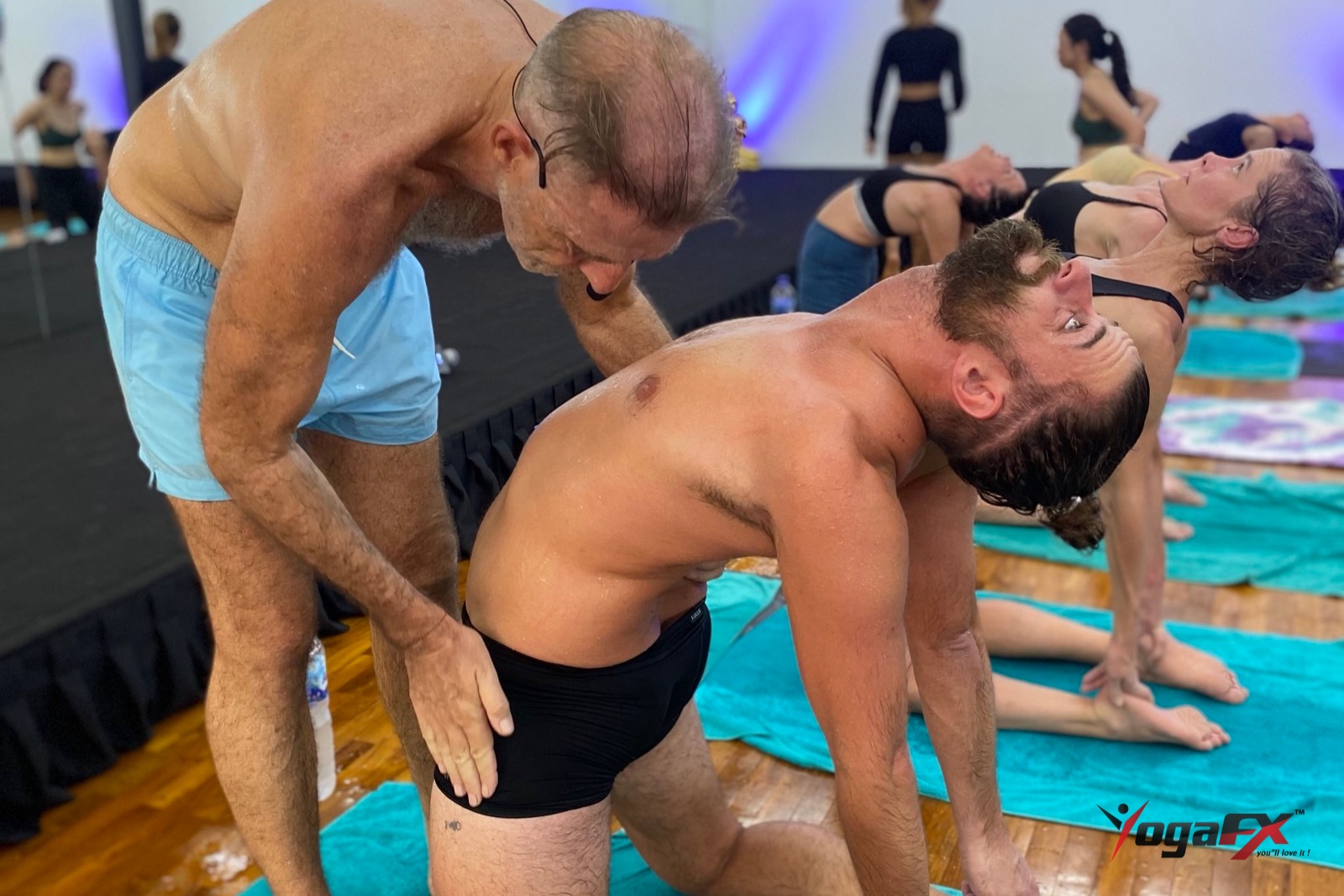
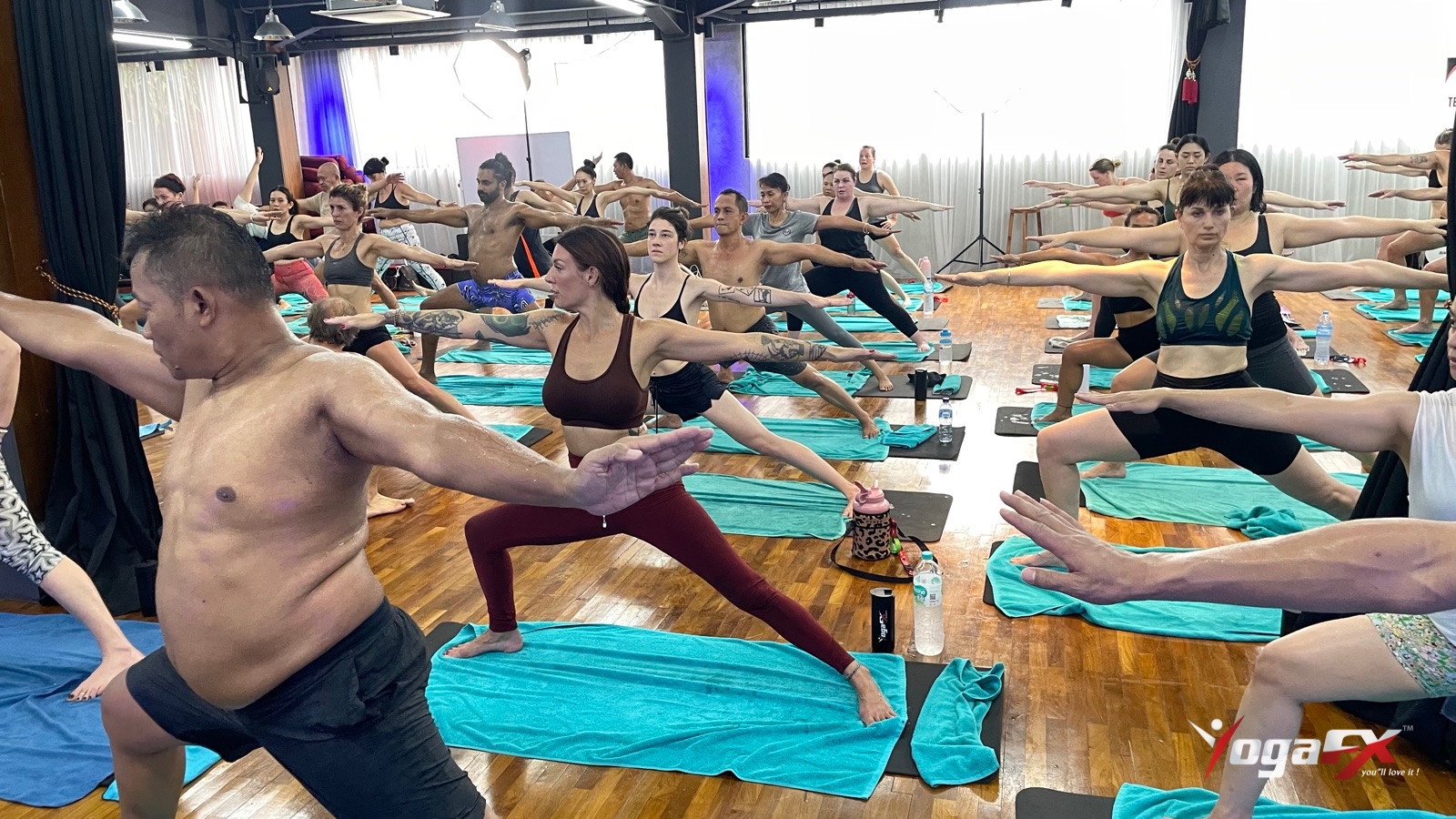
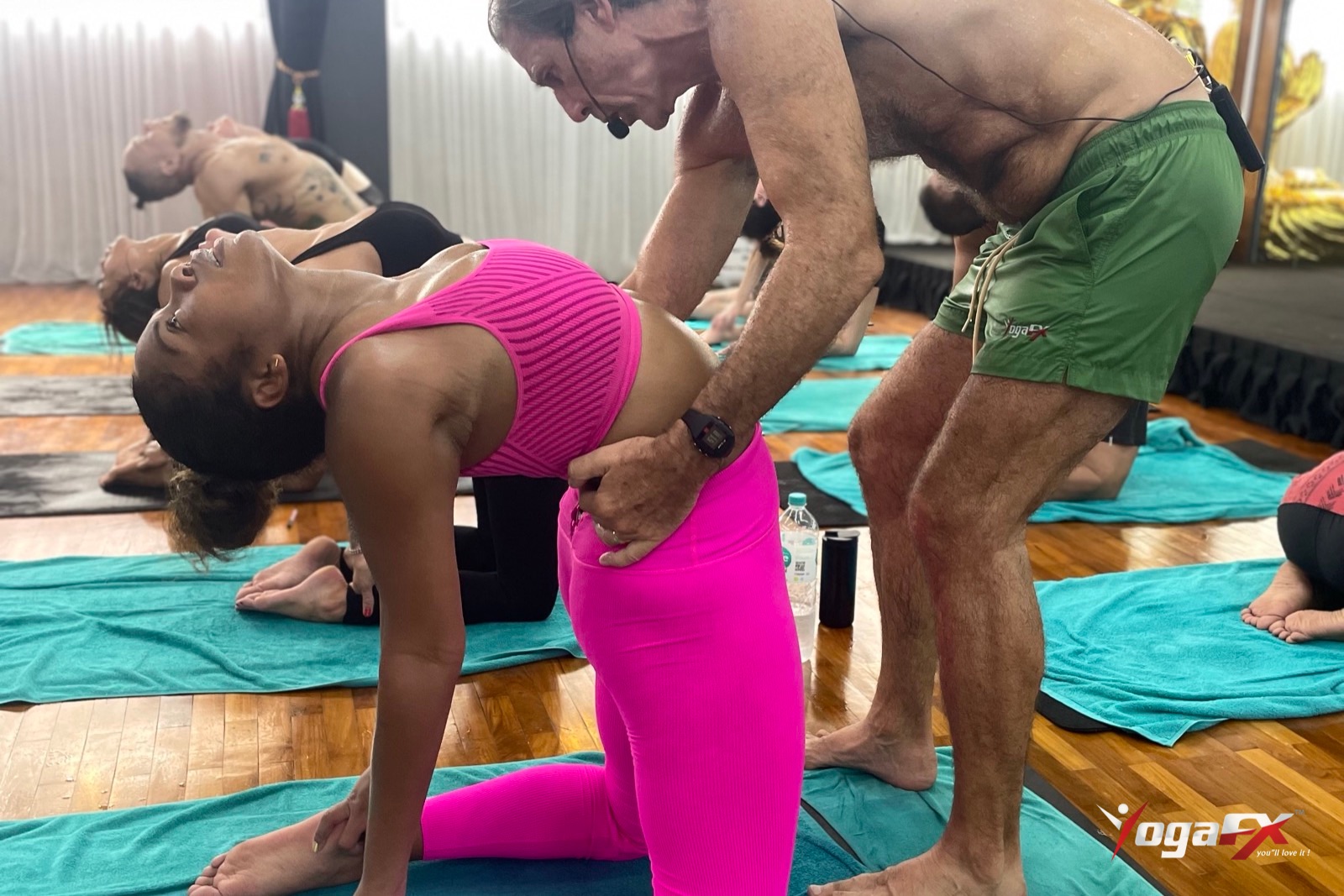
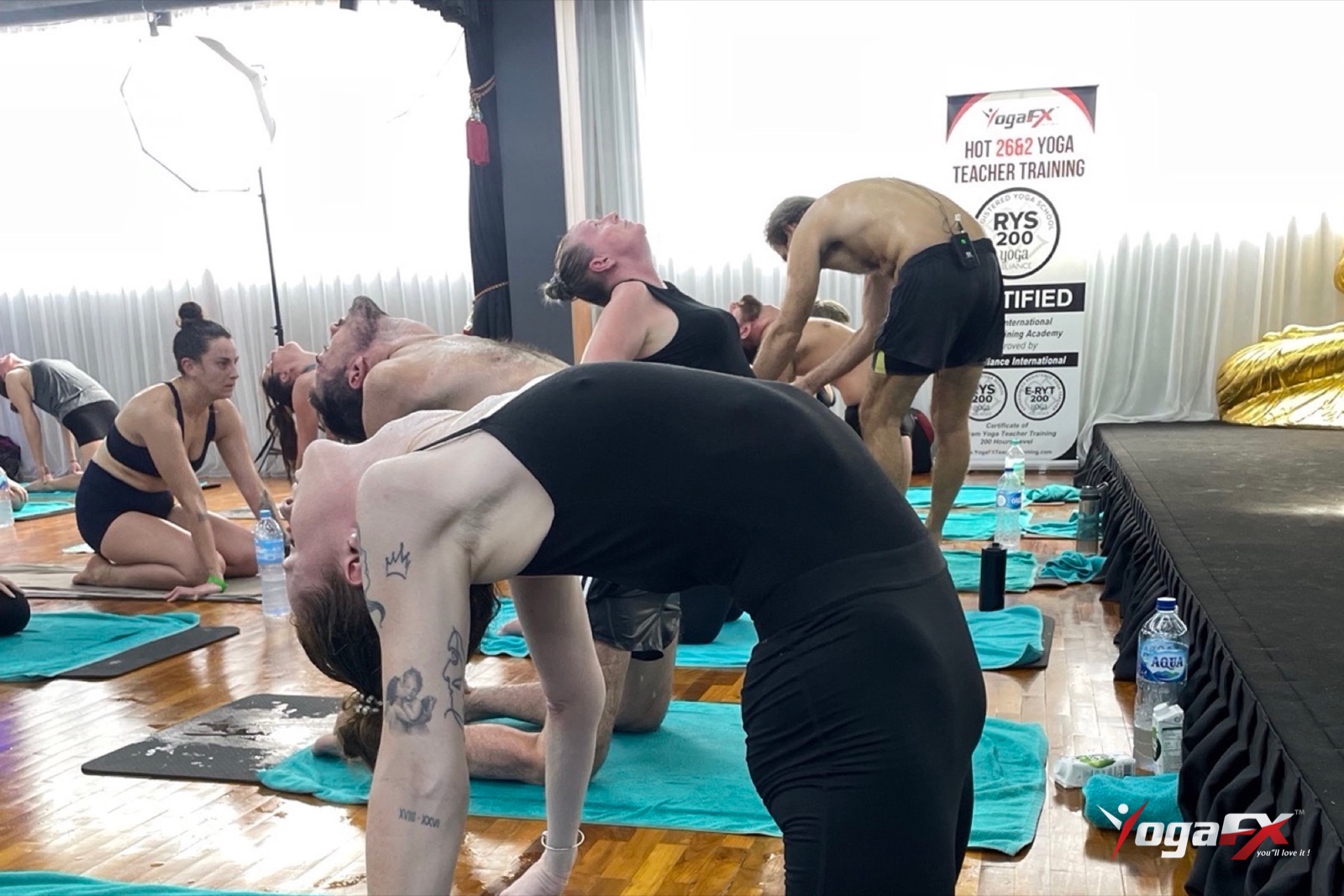
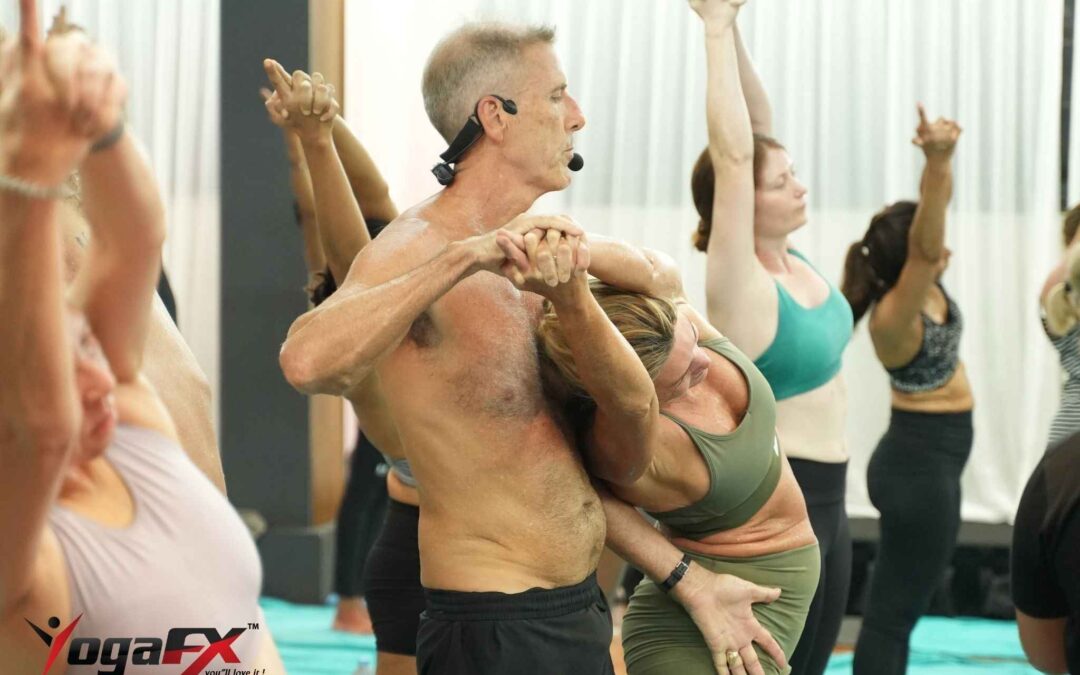
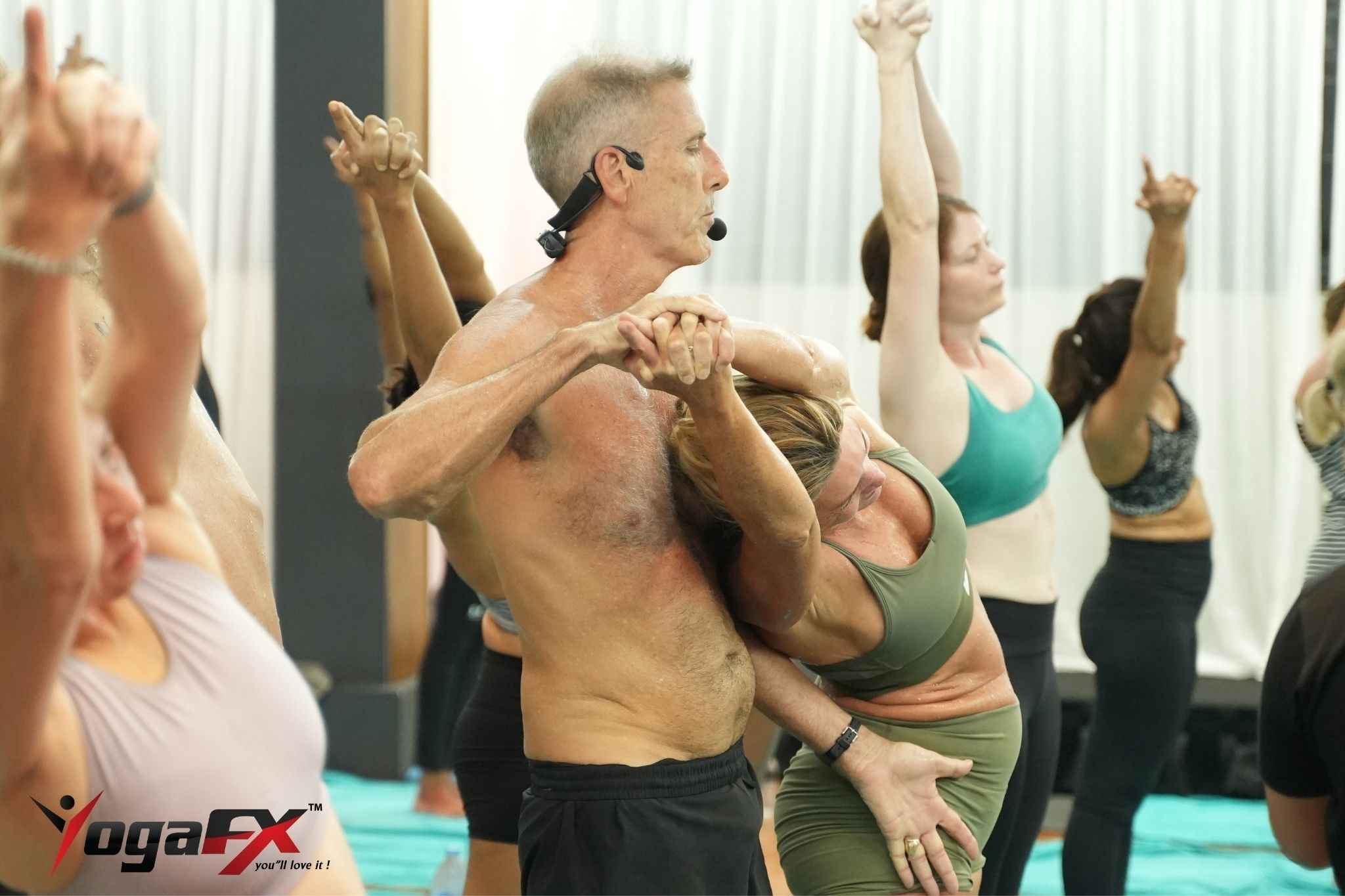
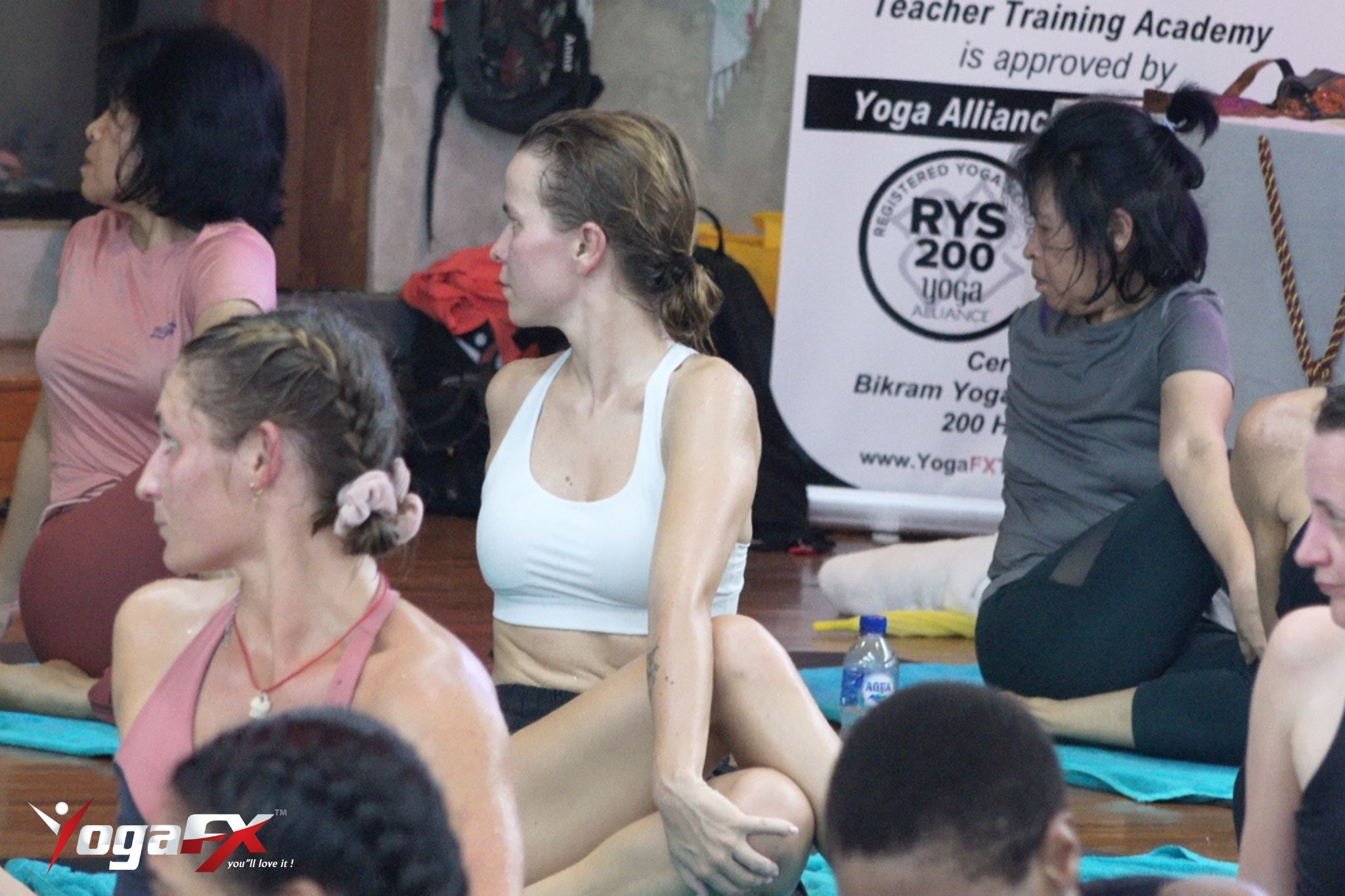
Hands-on guidance keeps a deep posture safe, whatever your age.
What the 2013 Hot Yoga Trial Measured, Group by Group
The team, led by Stacy Hunter, asked a simple question. Does a short course of hot yoga change arterial stiffness and the way the body handles insulin? To find out, they recruited two groups and gave both the same programme.
Each person attended 90-minute classes, three times a week, for 8 weeks. The room was heated to 40.5°C with 40 to 60 percent humidity. The younger group averaged 30 years old, and the middle-aged and older group averaged 53. Those 53-year-olds are the closest match to a man reading about yoga for men over 40.
More elastic arteries showed up only in the younger group.
Beta-stiffness index (higher means stiffer)
Decreased (p<0.05)
No significant change
Less stiffness, again in the younger group only.
Insulin resistance (HOMA-IR)
No significant change
Decreased (p<0.01)
The older group handled insulin better after 8 weeks.
Plasma insulin
No significant change
Decreased (p<0.01)
Lower fasting insulin fits the lower resistance score.
Cholesterol
Total and HDL fell (p<0.05)
Total and LDL fell (p<0.05)
Total fell in both. Only the older group's LDL fell.
Sit-and-reach flexibility
Increased (p<0.01)
Increased (p<0.01)
Both groups reached further.
Blood pressure, body fat, fasting glucose, triglycerides
No significant change
No significant change
The scale and the blood pressure cuff barely moved.
Results of an 8-week hot yoga programme in 24 younger and 18 middle-aged and older adults. Source: Hunter et al., Journal of Alternative and Complementary Medicine, 2013;19(12):930-934.
Read the table slowly and one thing stands out. The older group didn't get the artery benefit, yet they did get a clear metabolic one. In other words, the body can improve in one way while another measure stays flat. That's normal in exercise research, and it's a reason not to promise a single outcome.
Four Numbers From the Trial
18
Middle-aged and older adults
Average age 53, and the group closest to a reader of 40 or more.
3 x 90 min
The dose
Three classes a week for 8 weeks in a room heated to 40.5°C.
p<0.01
Insulin resistance, older group
The HOMA-IR score fell by a statistically clear margin.
No change
Artery stiffness, older group
Only the younger group's arteries became more elastic.
The 2013 hot yoga trial in four numbers. Source: Hunter et al., Journal of Alternative and Complementary Medicine, 2013.
How Strong Is This Evidence?
Honestly, it's a small, early study, so any claim about yoga for men over 40 should stay modest. The abstract describes the groups before and after the course, and it doesn't mention a control group that stayed home. So we can't say yoga caused the changes, rather than a new routine or the season. It also had no room-temperature group, which means it can't tell us whether the heat mattered.
Two more limits matter for men. The report doesn't present results for men on their own, and the trial wasn't men-only. So treat the findings on yoga for men over 40 as a signal worth testing, not a promise.
What the 2025 Review Adds for Men in Their 40s
One trial can mislead, so it helps to zoom out. The 2025 systematic review by Willmott and colleagues in Sports Medicine - Open pooled 43 hot yoga studies with 942 participants. Bikram-style practice made up 74 percent of the methods used.
The authors wrote that chronic hot yoga "appeared to elicit cardiometabolic (e.g. body composition, lipid profiles and macrovascular function) and functional adaptations applicable for health." That's encouraging, but it comes with a warning in the same abstract: "caution is advised as case studies report ill-health following hot yoga practice."
There's a gap that matters here too. Across those 942 participants, 76 percent were female. That means the evidence on men, and on yoga for men over 40 in particular, is thinner than most articles admit. Three honest limits follow from that:
Few men. Results from mostly female groups may not carry over exactly to male bodies.
Short trials. Most studies lasted weeks, so nobody knows what ten years of practice does.
Healthy volunteers. People with heart disease or poorly controlled blood pressure were rarely included.
None of this makes yoga a bad idea. It makes a gradual start a good one. You can read how researchers measured mood in men in our piece on hot yoga and mental health in men.
Why a Gentle, Unheated Start Makes Sense
Put the two sources together and a sensible order for yoga for men over 40 appears. The studies show benefits from regular practice, and the same studies leave open whether heat adds anything for men over 40. Hot yoga for men over 40 isn't off limits. It just deserves a slower runway.
So the cautious move is to build the habit first and add warmth only if your doctor agrees and your body is ready.
There's also a simple activity target to keep in mind. The CDC adult activity guidelines say adults need at least 150 minutes of moderate-intensity activity a week, plus muscle-strengthening activity on 2 or more days. A home yoga practice can sit alongside walking or cycling to help you reach that, rather than replace it.
If you're also thinking about teaching one day, our sister site explains a career-changer's route from living room to Bali, written for men weighing a change of career. This article stays with the body and the evidence.
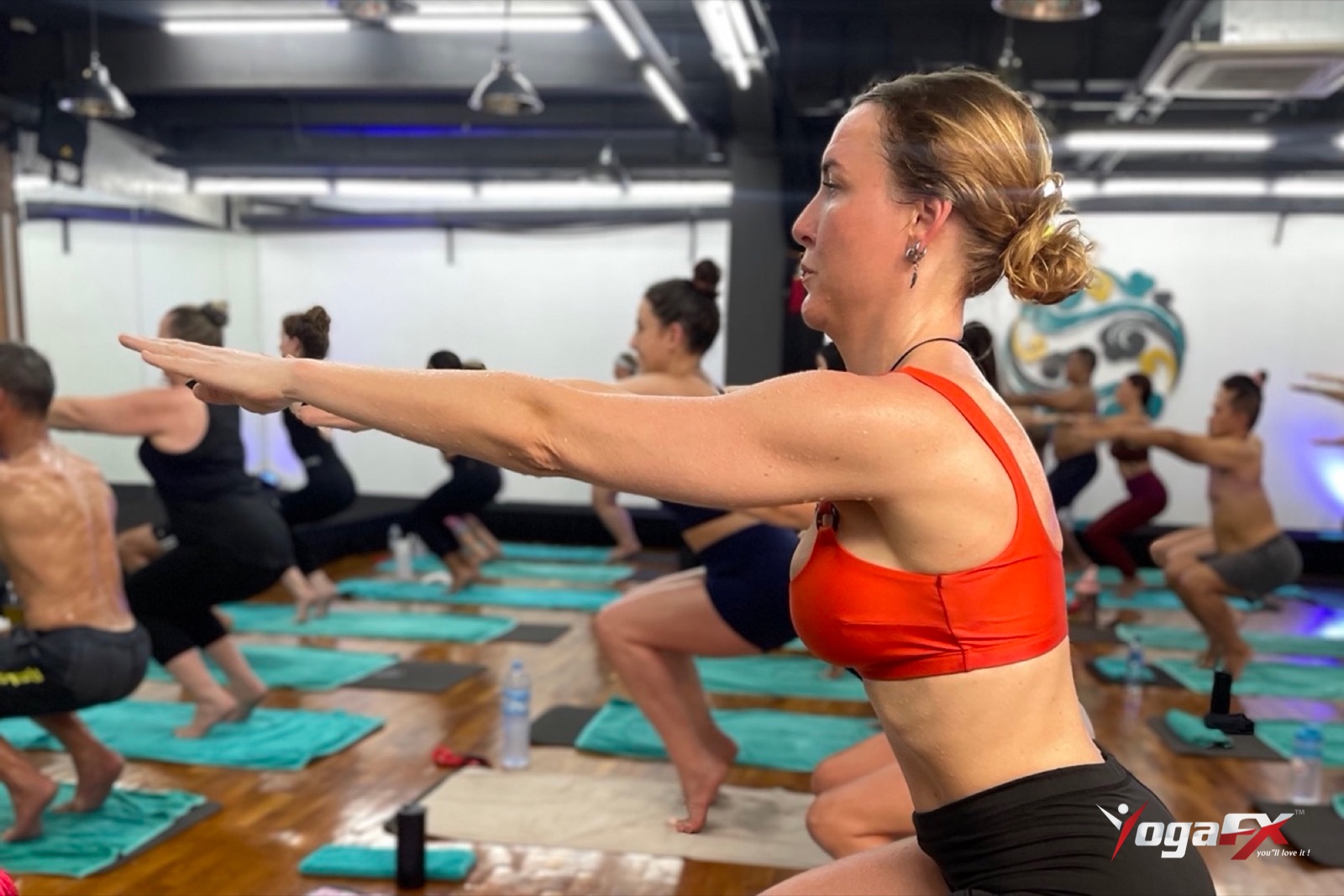
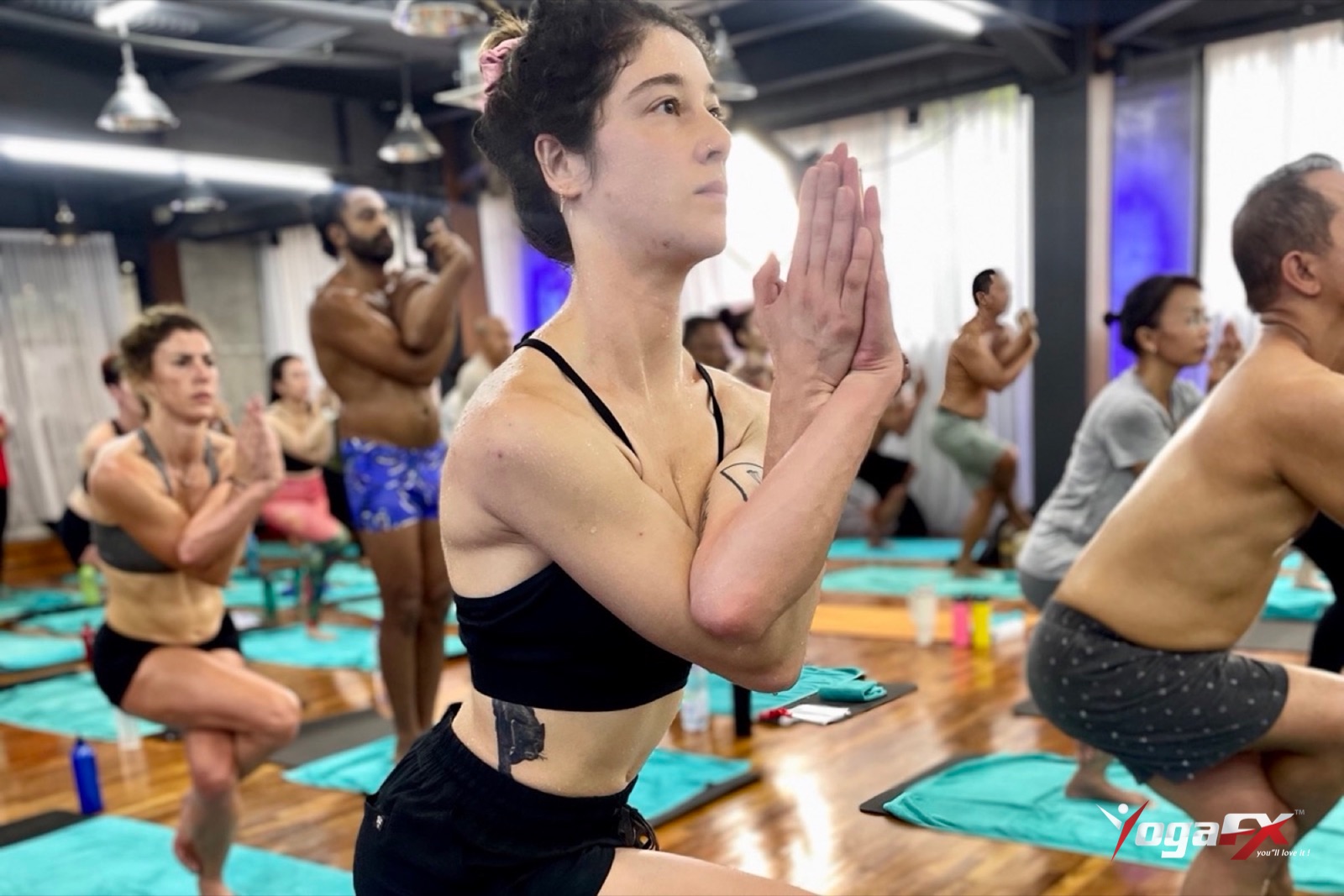
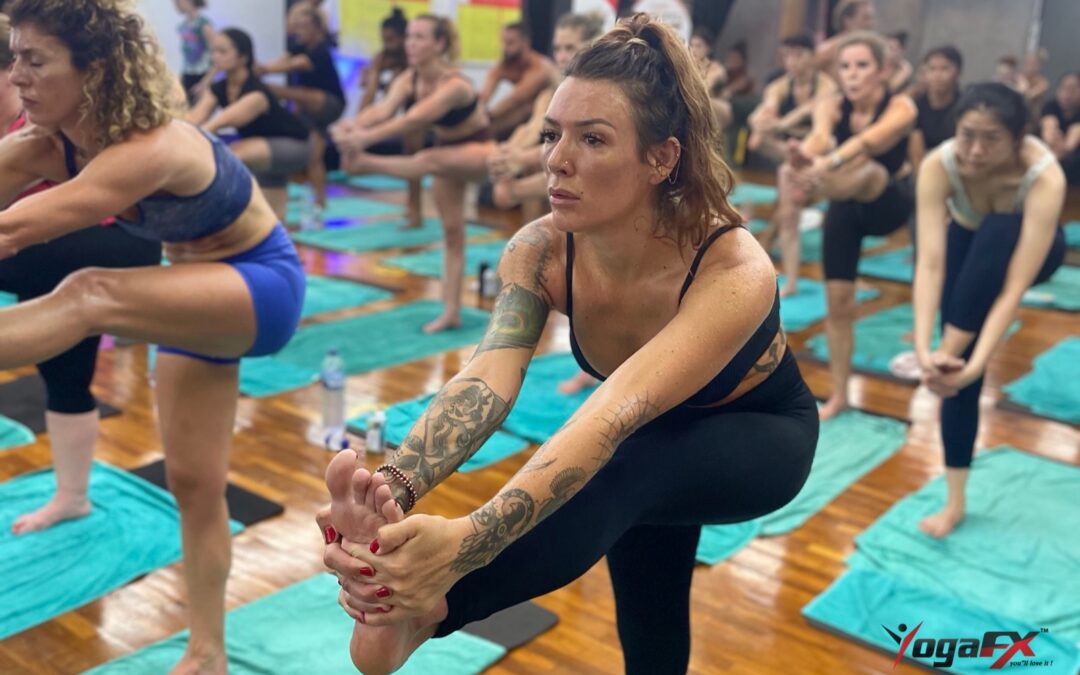
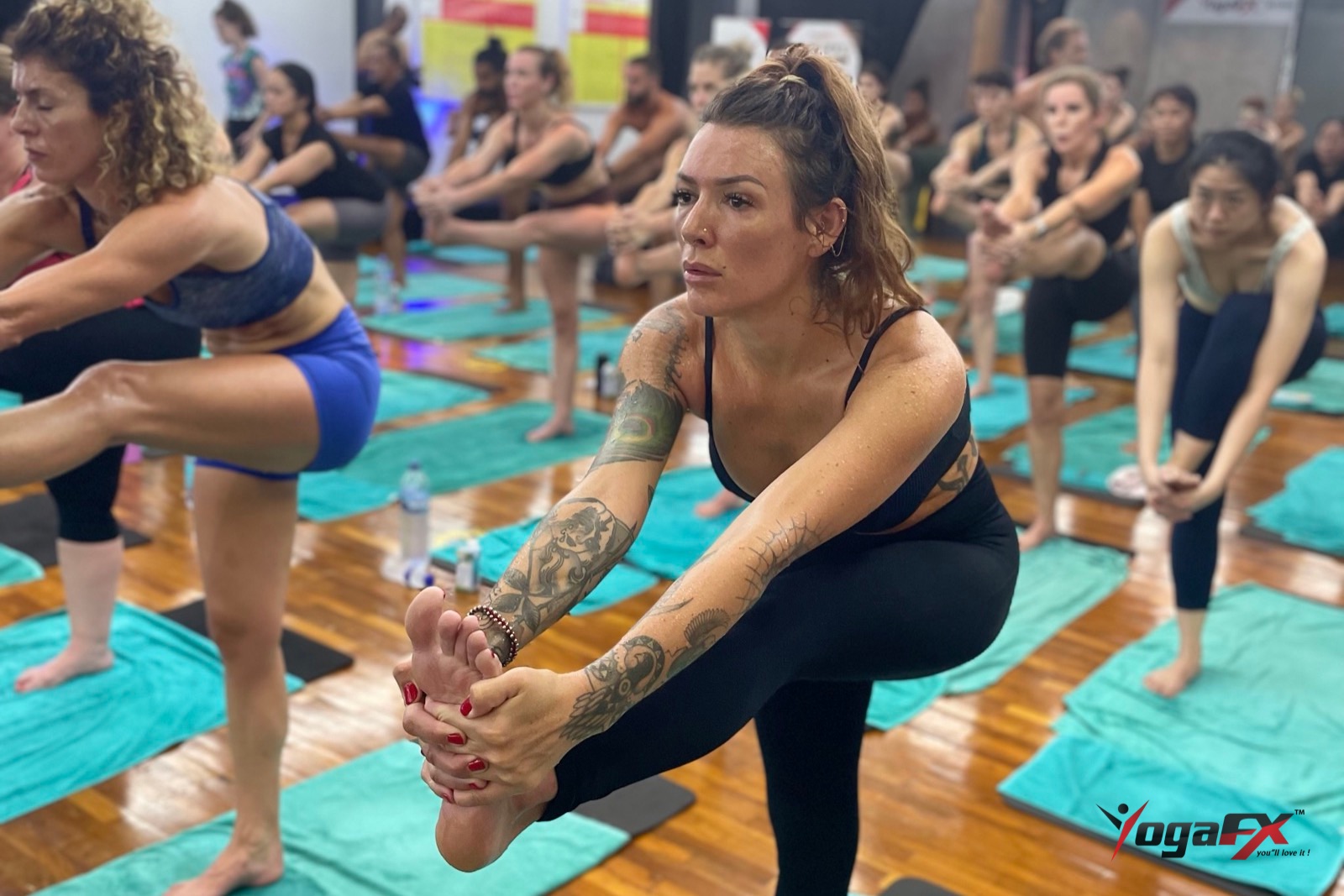
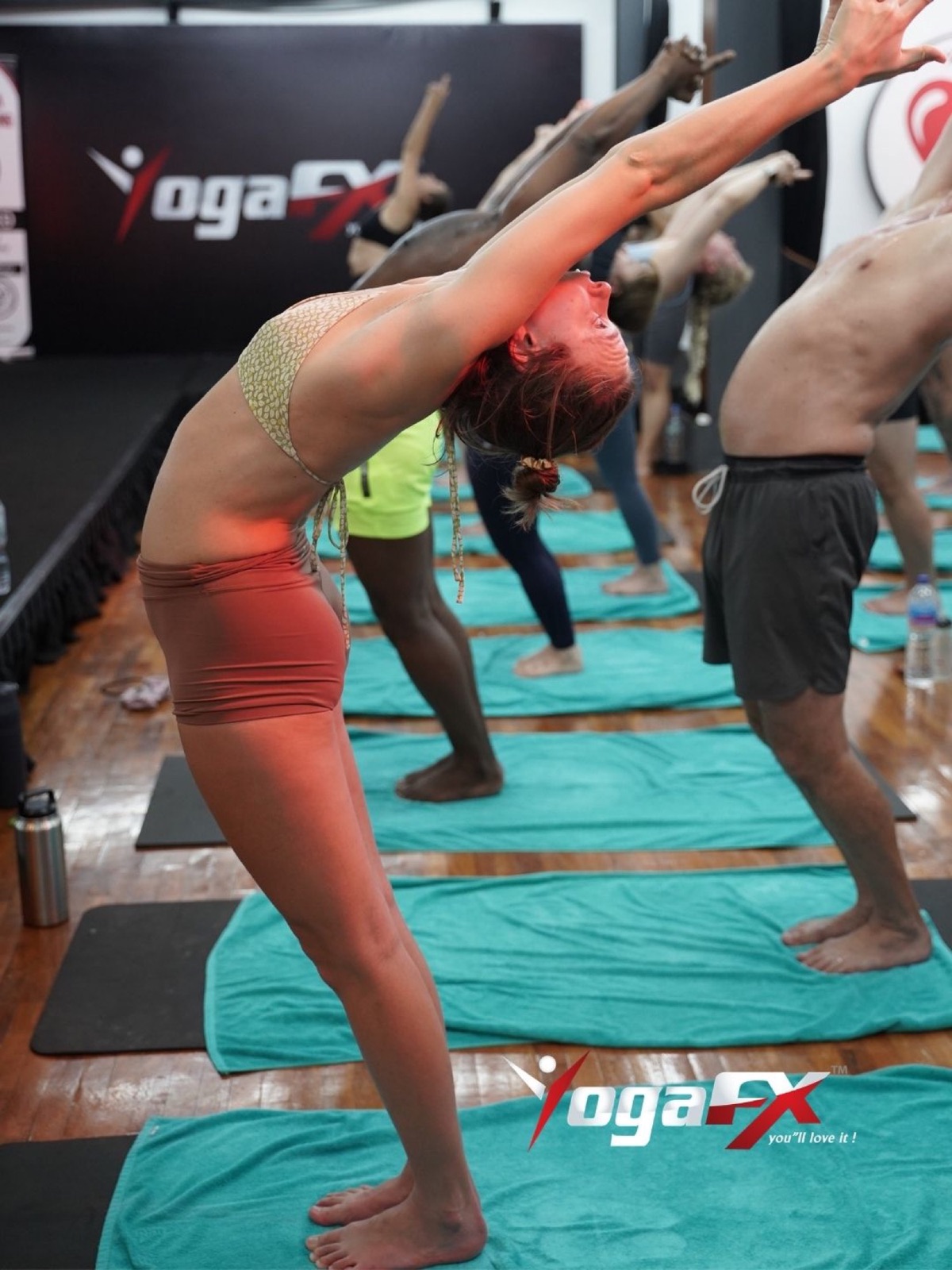
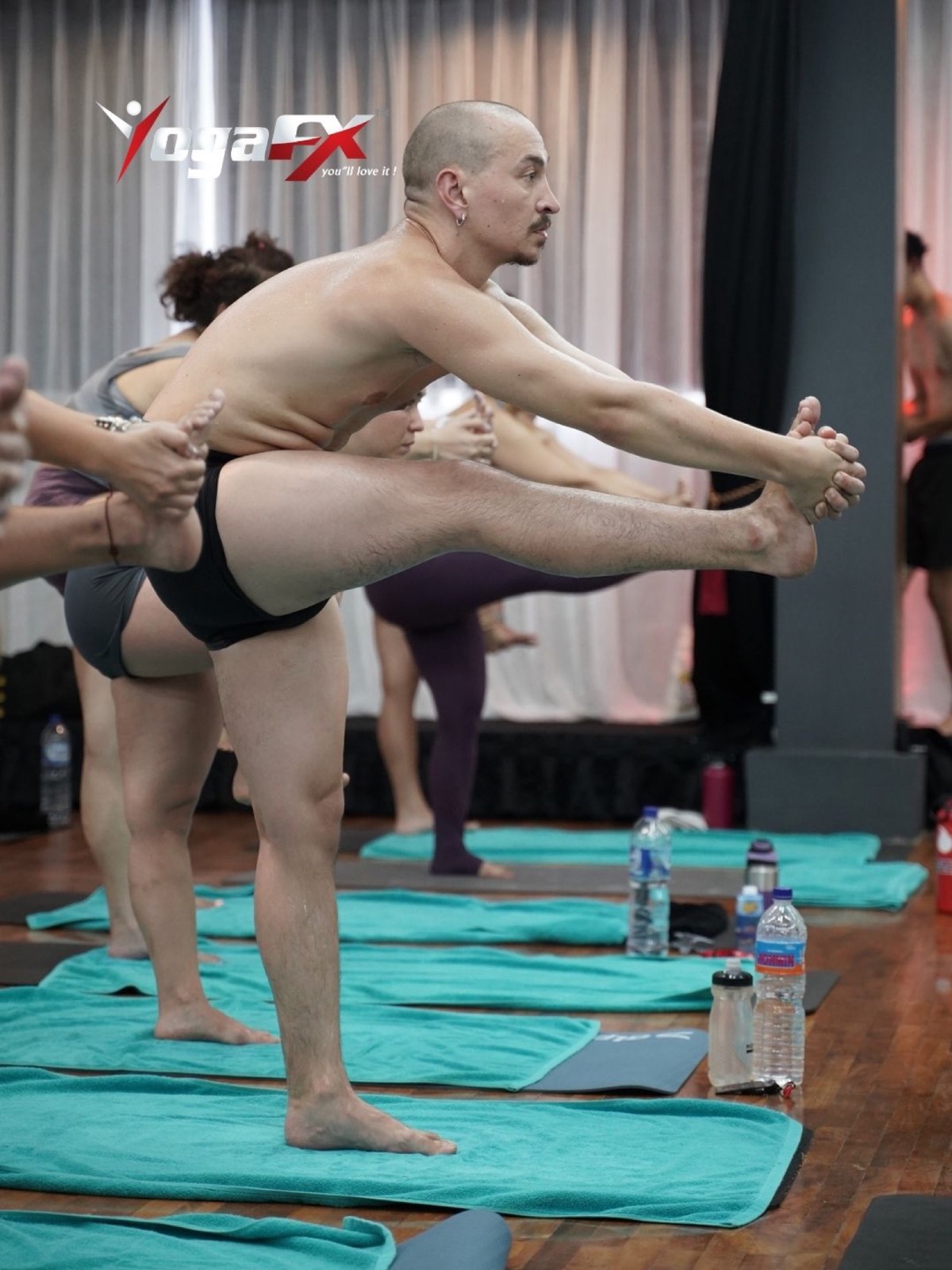
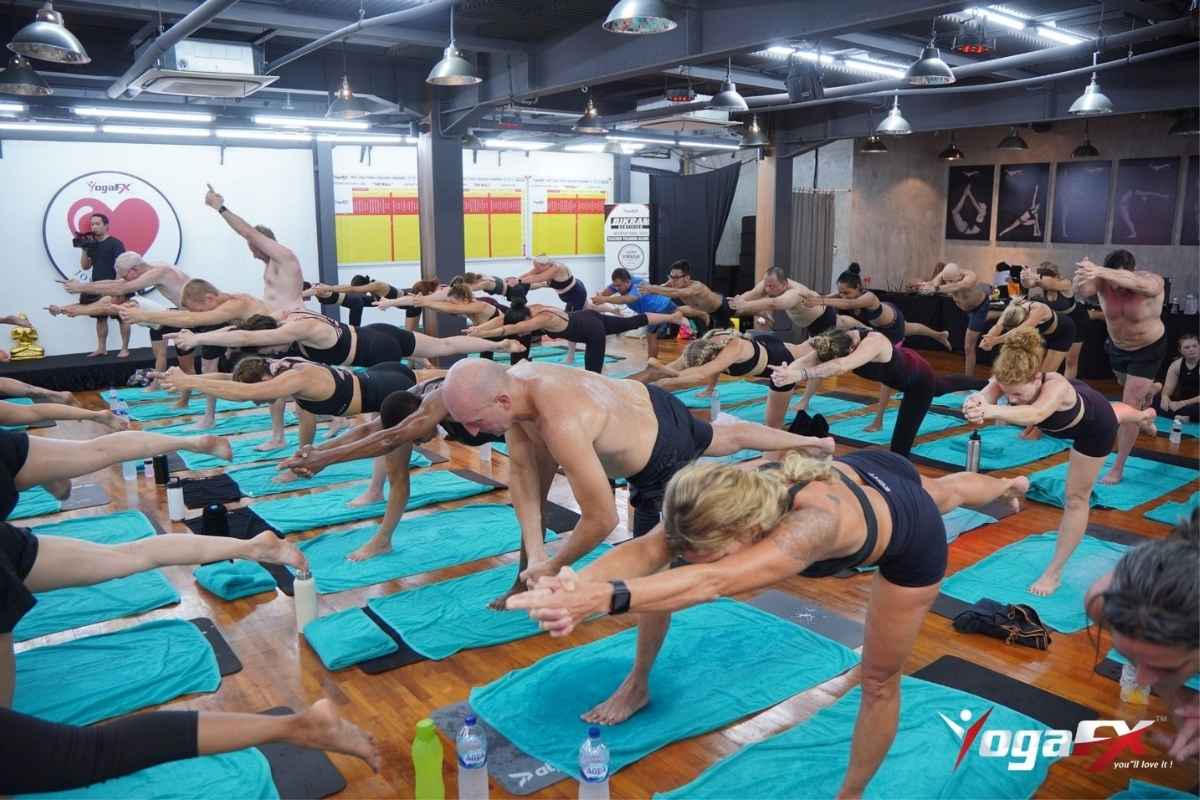
A standing posture in a heated room. At home you practise the same shapes without the heat.
An 8-Week Home Plan for Yoga for Men Over 40
Here's a plan for yoga for men over 40 that borrows the trial's rhythm of three sessions a week, but starts far shorter and cooler. It's our own progression, not a protocol from the study, so adjust it to how you feel. Posture names follow the 26&2 sequence, and our 26&2 poses guide shows what each one looks like.
Weeks 1 and 2: Breathe and Stand
Keep sessions to 15 or 20 minutes, three days a week, in a normal room. Week one of yoga for men over 40 should feel almost too easy, and that's the point. The aim is to learn shapes, not to sweat.
Standing Deep Breathing. Ten slow breaths, with the elbows lifting gently as you inhale.
Awkward Pose. Sit back only halfway and hold for about 15 seconds, twice.
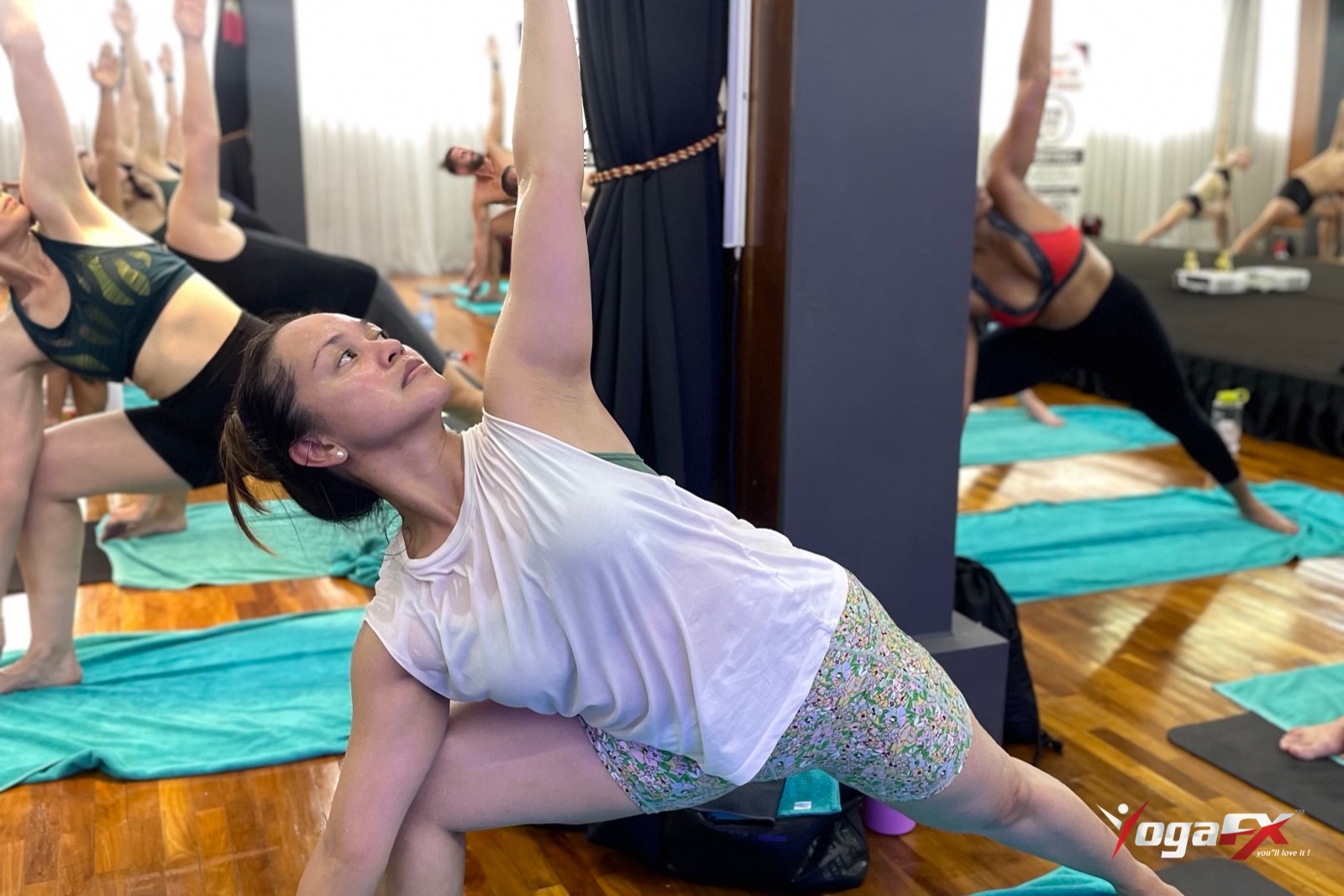
Half Moon. Take a small side bend with arms overhead, going only as far as the ribs feel free.
Wind Removing Pose. Lie on your back and hug one knee at a time to the chest.
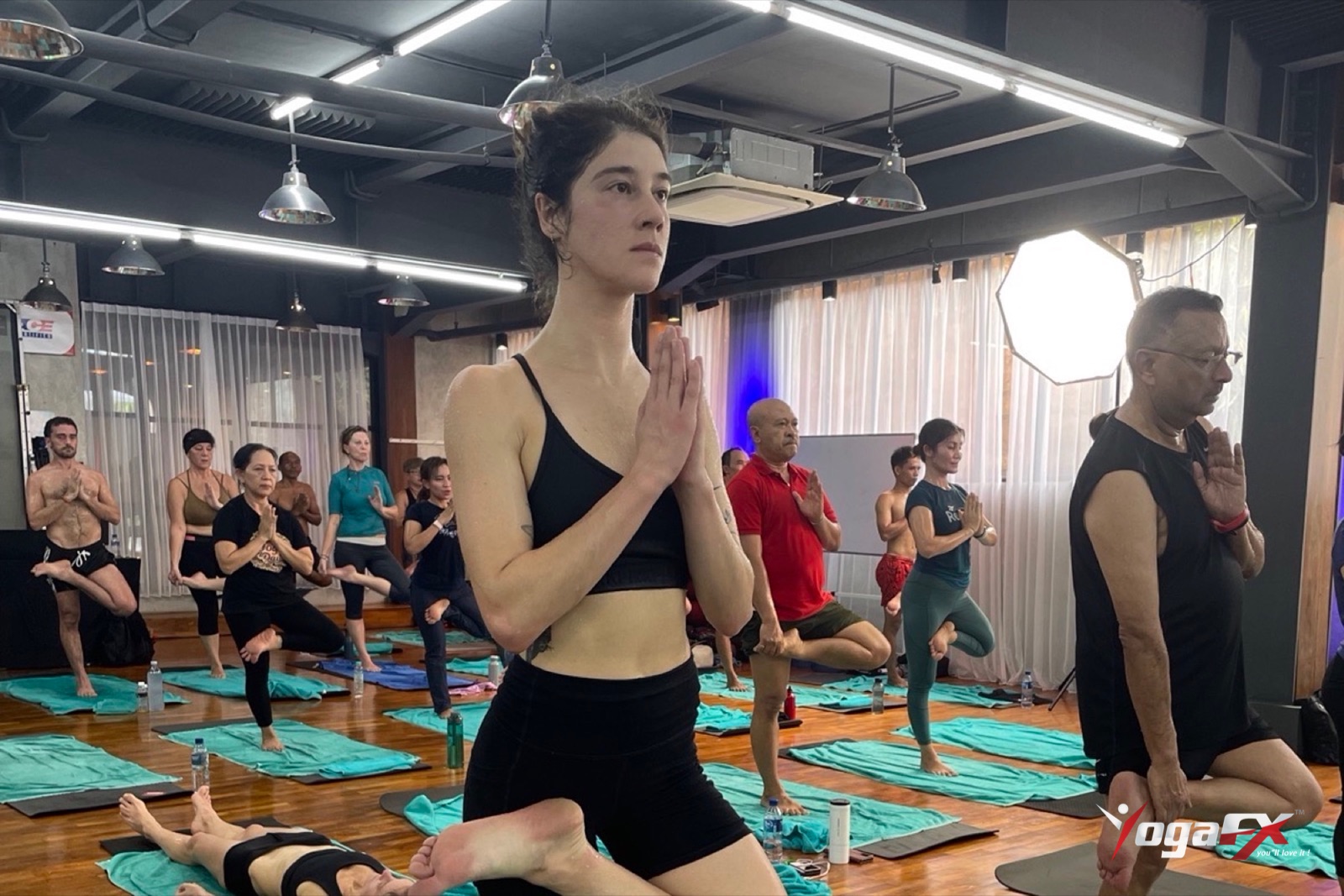
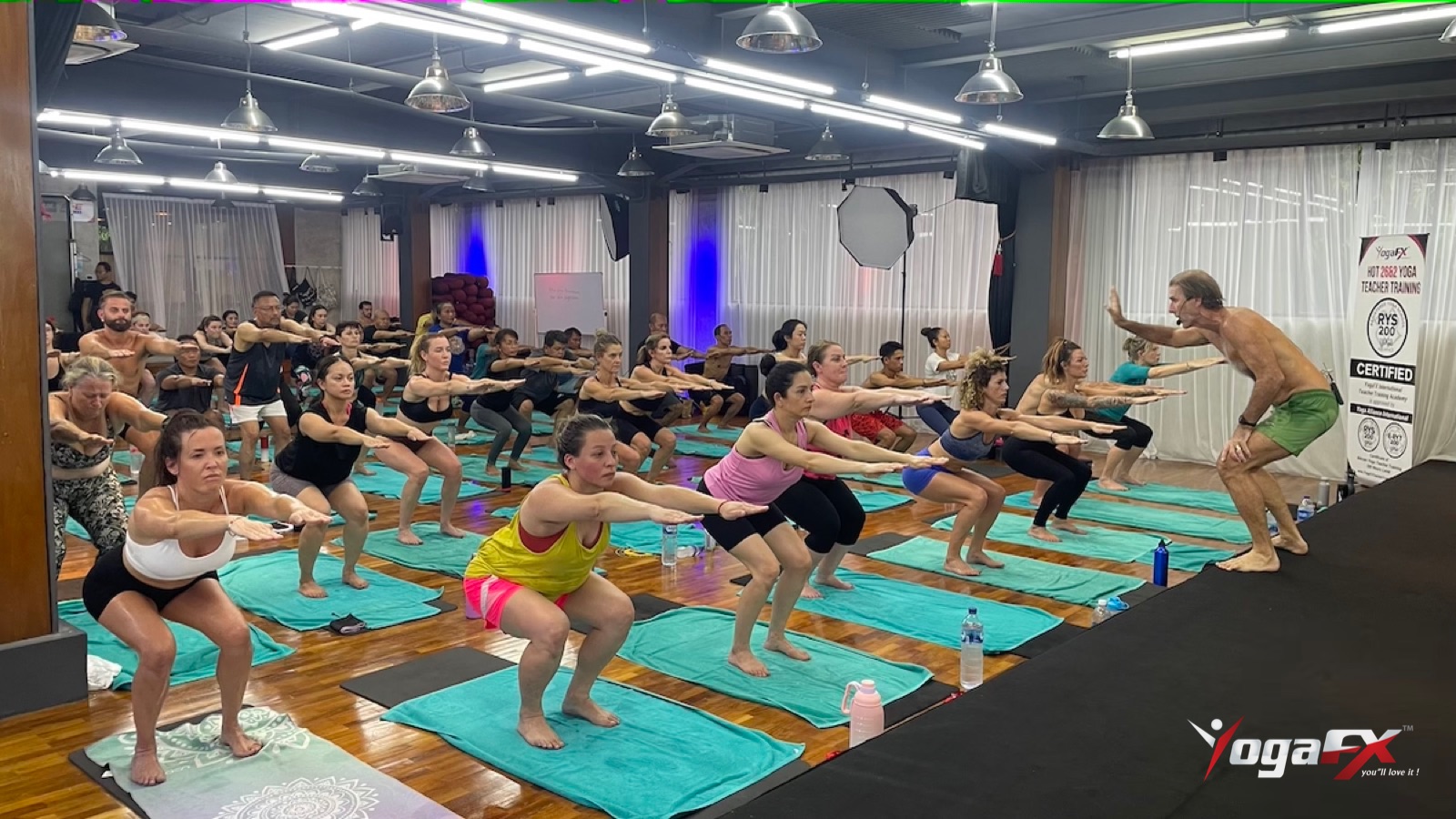
The opening breathing exercise needs no heat and makes a calm first week at home.
Weeks 3 and 4: Add a Second Set
Stretch sessions to 25 or 30 minutes. Do each posture twice, the first time at about 60 percent effort and the second time a little deeper. Bend your knees in any forward fold, because tight hamstrings often pull on the lower back.
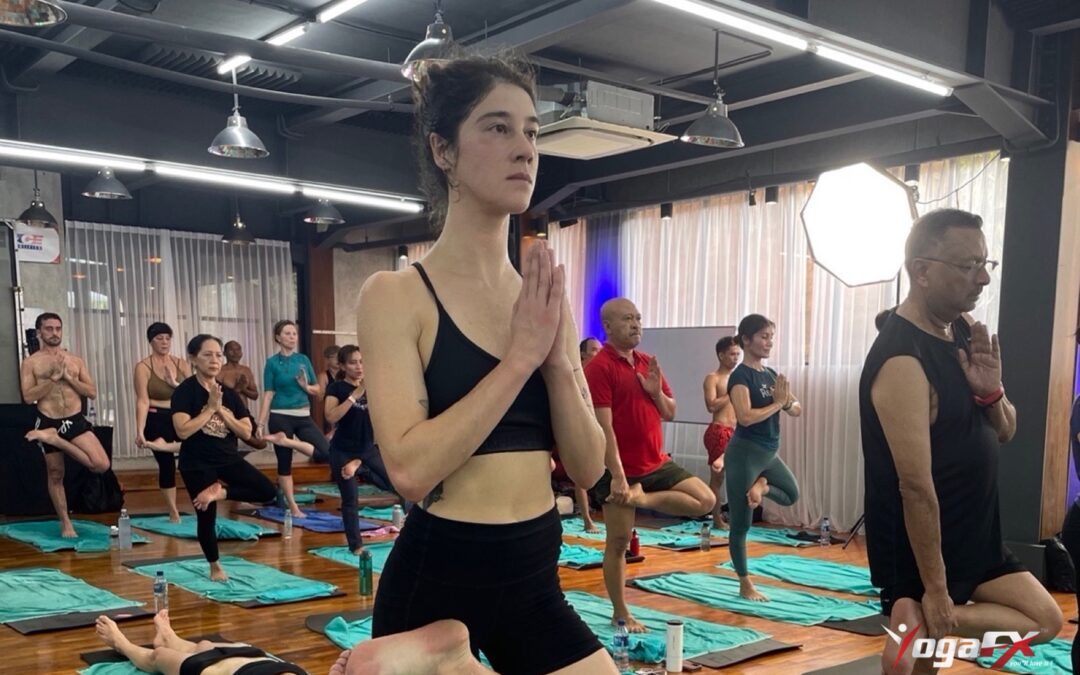
Tree Pose near a wall. Keep a fingertip on the wall for balance and let go once you feel steady.
Shallow Cobra. Lift only as high as your lower back stays comfortable.
Rest days in between. Recovery slows with age, so leave at least one day between sessions.
Weeks 5 and 6: Longer Holds
Lengthen sessions to 35 to 45 minutes. By now yoga for men over 40 should feel like a routine, not a project. Hold each standing posture a few seconds longer, and add Half Locust and a slow Cobra to the floor work. Notice how you feel the next morning. A little muscle ache is normal, but sharp pain in the back, knees or neck means you should ease off.
Weeks 7 and 8: A Warmer Room, If Your Doctor Agrees
Now you can practise for 45 to 60 minutes. This is the stage where yoga for men over 40 starts to look like the trial's classes, minus the heat. If your doctor has cleared you, try the warmest part of the day or a closed, sunny room. Don't use a space heater to copy a heated studio, because uncontrolled heat is exactly what the case reports in the 2025 review warn about. When you feel ready, a first class in a heated studio is the natural next step.
Rules for Every Session
The best yoga for men over 40 is the kind you can repeat three times a week without a setback. These rules protect that habit, heated or not.
Drink steadily. Sip water through the day rather than gulping before you start.
Stop and sit if you feel dizzy, light-headed, nauseous or short of breath.
Get urgent help for chest pain, a racing or irregular heartbeat, or confusion.
Keep a note. Write down how long you practised and how you felt, so you can spot patterns.
Who Should Check With a Doctor First
Men in their forties often carry a quiet health issue they don't know about yet. Yoga for men in their 40s is low impact, yet that's exactly why a quick check before you begin is smart, not timid. Talk to a healthcare professional first if any of these apply to you:
A heart condition or a family history of early heart disease.
High blood pressure that isn't well controlled, or regular dizzy spells.
Diabetes or pre-diabetes. Exercise changes how medication works, and heat can add to that.
Medication that affects fluid or heat balance, such as some blood pressure tablets and diuretics.
If your doctor says yes, share the plan above and ask which parts to skip. For a longer look at heat, blood pressure and who should be careful, see our review of hot yoga and your heart.
What Our Trainees Say About the Experience
Reviews can't tell you anything about arteries. They can tell you what it feels like to learn in a supportive room, which matters if you're nervous about starting later in life. These come from graduates of YogaFX teacher trainings.
The best Yoga Teacher Training I ever had so far... Really grateful I had the opportunity to learn from the master Mr. Ian.
Nadya, Google review, 2026
Mr. Ian is an absolute Legend and a truly professional in the field... Made everyone feel at home, pushed everyone to leave the own comfort zone and create personal development.
Lars, Google review, 2025
...it's the overall experience all the little touches... the whole experience that you provided for all of us...
You can watch Gary's full video review below. It was recorded at the end of a Bali training.
Learn the Method Behind the Research With YogaFX
The postures in these trials come from one fixed sequence, now taught as Original Hot 26&2 Yoga. Because the sequence never changes, a student can learn it at home and know exactly what comes next. That's what makes it a good fit for yoga for men over 40 who want a careful, evidence-minded start.
Our course is led by Mr. Ian Terry, E-RYT 500, who has more than 12,000 teaching hours. He trained for 5 years, from 2014 to 2019, with the founder of the method. Since 2017, YogaFX has trained more than 1,500 graduates from over 80 countries, and Mr. Ian teaches every posture by voice, so you hear the cues for your own body. For yoga for men over 40, that spoken guidance is often the missing piece.
Finish in Bali. The 6-day Bikram Hot 26&2 Yoga Teacher Training MasterClass next checks in on Sunday 24 January 2027 at Soham Wellness Center in Seminyak, and ends Friday 29 January.
Graduates earn the Yoga Alliance RYT 200 and the Bikram Hot 26&2 200-Hour International Yoga Certification. The Early Bird price is US$1,899 (normally US$1,999), and payment plans start from US$250 a month with no interest.
FAQ
How often should men over 40 do yoga?
Aim for two or three sessions a week and build up slowly. The 2013 hot yoga trial used three 90-minute classes a week for 8 weeks, but those were heated classes. At home, three shorter sessions of 20 to 40 minutes are a realistic start. Add a rest day whenever you feel sore.
How much exercise should a 40-year-old man get?
The CDC says adults need at least 150 minutes of moderate-intensity activity a week, plus muscle-strengthening on 2 or more days. Hold-based yoga postures may add to your strengthening time, but they work best alongside walking or other cardio. Check with your doctor first if you have a health condition.
Is chair yoga enough for men over 40?
It can be a good starting point if you are stiff, sore or returning after a long break, because it lowers the balance demand. No study we reviewed compared chair yoga with hot yoga, so nobody can say they match. Move to standing postures once you feel steady, and ask your doctor about your own limits.
What is a good yoga routine for men over 40?
Yoga for men over 40 works best when it starts with breathing, a few standing postures such as Awkward Pose and Half Moon, and gentle floor work like Wind Removing Pose. Keep sessions to 15 to 30 minutes, three times a week, then lengthen them over eight weeks. The home plan above shows each step.
Is hot yoga safe for men over 40?
Hot yoga hasn't been shown to be safe for everyone. A 2025 review of 43 studies says caution is advised because case studies report ill-health after hot yoga. Men with heart conditions, high blood pressure or heat-sensitive medication should talk to a doctor first, and begin with unheated practice.
Hot yoga for anxiety has promising signals but no clear verdict yet. The best-known trials measured depression, well-being and stress hormones, not anxiety scores. So is hot yoga good for anxiety? It may help some people feel calmer, and the heat can make others feel worse. Here is what the data covers.
Is Hot Yoga Good for Anxiety? The Short Answer
If you typed "is hot yoga good for anxiety" into a search box, you probably want a straight answer, so here it is. Maybe, for some people, but nobody has proven it. Hot yoga for anxiety sits in a gap. Related research is encouraging, yet none of the trials we read was built to test anxiety.
We teach hot yoga, so we want to be careful. Anxiety is a real health condition, and the people reading this are often tense and tired. Hope is fair. Hype is not. Below, we look at what each trial measured, what it left out, and how you could try a class safely.
Here is the evidence on hot yoga for anxiety in four lines:
It does show that 8 weeks of heated yoga cut depression scores far more than waiting did, in one trial.
It does show that a six-week hot yoga course improved well-being in healthy adults.
It does not show that hot yoga lowers anxiety scores, because anxiety was not the main outcome in these trials.
It does not show that hot yoga can replace therapy, medication or medical advice.
Mr. Ian Terry, E-RYT 500 and founder of YogaFX, has taught more than 12,000 hours of Original Hot 26&2 yoga. He tells every student the same thing: a class can sit beside care, but it is never a substitute for care.
What the Hot Yoga for Anxiety Research Actually Measured
Most articles on hot yoga for anxiety quietly borrow results from studies about something else. That is understandable, because the topics overlap. Still, a depression score is not an anxiety score, so we checked what each study counted. We opened each source below before using it.
The Massachusetts General Hospital Depression Trial
This is the study everyone cites. Maren Nyer and colleagues ran an 8-week randomised trial of heated yoga for adults with moderate to severe depression, published in the Journal of Clinical Psychiatry in 2023. According to MGH Psychiatry News, 80 people were randomised and 65 were analysed.
The headline result was large. About 59% of the yoga group cut their depression symptoms by half or more, against about 6% of the waitlist group, and the effect size was large (Cohen d of 1.04). The only outcome named in the abstract was a clinician-rated depression scale. Anxiety was not reported. You can read the published abstract yourself.
The Six-Week Well-Being Trial in Healthy Adults
A team led by Bryant Hui recruited 290 healthy volunteers who had never done yoga. Half took up to four free 90-minute hot yoga classes a week for six weeks, and half waited. Attendance averaged 17 classes. The group that practised reported better mindfulness, peace of mind and general health, according to the full paper in Psychosocial Intervention.
That sounds close to anxiety relief, but it is not the same thing. The study measured well-being, mindfulness and mood in the moment. It did not use an anxiety questionnaire. It also had no active comparison group, so it could not separate the heat from the exercise.
The Cortisol and Stress-Eating Trial
Lindsey Hopkins and colleagues studied 52 women at risk of obesity-related illness, with elevated stress and emotional eating. The yoga group practised Bikram yoga for 8 weeks in a room heated to 104°F, while the others waited. The trial, in the Journal of Consulting and Clinical Psychology, looked at stress hormone reactivity and binge eating.
Results were mixed and, in the authors' own word, preliminary. The cortisol benefit showed up only in women who started out as high reactors. Also, just 37% of the yoga group attended the two classes a week they were asked to. Anxiety was not the target here either.
What Participants Said in Their Own Words
After the MGH depression trial, researchers interviewed 57 participants. In that qualitative paper, 7 people (12.3%) described reduced anxiety. At the same time, 64.9% described both positive and negative effects of the class. Interviews are not measurements, but they do tell us the experience is mixed.
0 of 3
Trials aimed at anxiety
Main outcomes were depression, well-being and cortisol, not anxiety scores.
7 of 57
Mentioned less anxiety
In exit interviews after the MGH trial (12.3%). A story, not a score.
290
Healthy adults, 6 weeks
Better mindfulness and general health, with no anxiety questionnaire.
37%
Met the class target
Share of the yoga group who attended twice a week in the 2016 cortisol trial.
64.9%
Felt good and bad effects
Share of interviewed MGH participants who described both kinds.
What the main hot yoga trials counted, and what they left out. Sources: Nyer et al. 2023 and the 2024 participant-experience paper (MGH), Hui et al. 2022, Hopkins et al. 2016.
The Evidence for Hot Yoga for Anxiety, Graded
Not every source carries the same weight, so it helps to line them up. The table below shows who took part, what each source counted, and whether anxiety was in the picture. Read the last two columns first, because the gaps are the honest part of the story.
Source
Who took part
What it compared
Anxiety measured?
What it can tell you
MGH randomised trial (Nyer et al. 2023)
65 analysed adults with moderate to severe depression
Heated yoga vs waitlist, 8 weeks
Not reported
Large drop in depression scores
Well-being trial (Hui et al. 2022)
290 healthy, yoga-naive adults
Hot yoga vs waitlist, 6 weeks
No
Better mindfulness and general health
Cortisol trial (Hopkins et al. 2016)
52 women at risk of obesity-related illness
Bikram yoga vs waitlist, 8 weeks
No, stress and eating
Preliminary cortisol benefit in high reactors
Participant interviews (Nyer et al. 2024)
57 people from the MGH trial
Nothing, interviews only
Only as a theme (7 people)
How the class felt, good and bad
Forum posts and testimonials
Self-selected people
Nothing, no control
Sometimes
That some people feel better
Hot yoga for anxiety evidence graded by design and gaps. Sources: MGH Psychiatry News, Hui et al. 2022, Hopkins et al. 2016, Nyer et al. 2024.
Notice what every row shares: a waitlist or no control at all. Because of that, nobody can say whether the heat, the exercise, the routine or the company did any work. That limit applies to every claim you will read about hot yoga for anxiety, including ours.
Why Anxiety and Depression Are Not the Same Question
It is tempting to treat the depression result as an anxiety result. After all, the two often travel together, and plenty of people have both. However, they are different conditions with different symptoms and different treatments, and a trial for one cannot be quietly stretched to cover the other.
Anxiety tends to involve worry, a racing heart, tight muscles and a sense of threat. Depression tends to involve low mood, low energy and lost interest. Hot yoga for anxiety could plausibly help where it does not for depression, or the other way round. Or it could do neither. That is exactly why a trial with an anxiety scale as its main outcome would be so useful.
Four Ideas Researchers and Teachers Suggest
Nobody has proved a mechanism. Even so, these four ideas come up often, and they are worth treating as hypotheses:
Structure. A fixed class at a fixed time gives a restless day a shape.
Breath and attention. Slow breathing and a demanding posture leave little room for worry loops.
Predictability. A scripted class with no surprises can feel safe for a nervous mind.
Company. Sharing a room, without having to talk, can ease isolation.
Each idea fits what students tell us. None of them is a finding. For the stress hormone side of the story, read our review of whether hot yoga increases cortisol, which covers the short rise during class and the calmer response later.
Can Hot Yoga Make Anxiety Worse?
Yes, for some people, and it is the part most articles skip. A heated room is a physical stressor. Your heart rate climbs, you sweat heavily, and the air feels thick. A fast heartbeat and shallow breathing can feel a lot like panic, even when nothing is wrong.
So hot yoga for anxiety can go either way: the same class that settles one student can unsettle another. Our look at hot yoga as a cardio workout shows how high the heart rate can run. If you already notice your heartbeat when you are nervous, expect the first few classes to test you.
Signs to Slow Down or Leave the Room
Dizziness, nausea or a pounding headache.
A heartbeat that does not settle during the rest postures.
A rising wave of panic that breathing does not ease.
Tingling, confusion or feeling faint.
Leaving the room is allowed. Sitting out a posture is allowed. In fact, learning to notice these signals and respond calmly is part of the skill, and no good teacher will push you past them. Anyone trying hot yoga for anxiety should hear that on day one.
Hot Yoga for Anxiety Is Not a Substitute for Care
Anxiety is common, and it responds well to treatment. Hot yoga for anxiety is, at most, an addition some people find useful. It does not replace a doctor, a therapist or prescribed medication. Harvard Health says the same about the depression research: talk to your doctor before trying it.
Who Should Check First
Please speak to a healthcare professional before your first class if any of these apply:
Heart or blood pressure problems. Heat raises heart rate, so ask first. Our review of hot yoga and heart health explains why.
Medication that affects heat tolerance. Some medicines change how you sweat or regulate temperature. Your prescriber can tell you.
Pregnancy, a history of fainting or heat illness. Heated rooms carry extra risk for these groups.
Panic attacks. If you get them, tell your doctor and the teacher before you start.
Current treatment. Never stop or lower medication because yoga feels helpful. Changes belong with your prescriber.
Signs You Need More Than a Class
See a healthcare professional soon if worry is constant, if you avoid normal life because of it, if sleep or appetite change a lot, or if you are using alcohol to cope. If you are thinking about harming yourself, call or text 988 in the US, or contact your local emergency number, today. Hot yoga is not a crisis tool.
Trying Hot Yoga for Anxiety: A Careful Plan
Say your doctor agrees, and you want to try hot yoga for anxiety yourself. The safest approach copies what the trials did, but gently. Start well below the research dose and build only if you feel good. This plan follows that logic.
Check with your doctor first. Mention the heat, any medication and any panic history.
Tell the teacher you are new and nervous. A good teacher will show you where to stand, and that the door is yours to use.
Start with one class a week. The trials asked for two, but they also saw attendance fall short, so one is a fair beginning.
Build toward two a week only when you recover well and sleep normally.
Rate your anxiety from 1 to 10 before and after each class. A simple note shows what changes over weeks, not hours.
Drink water, rest when you need to, and skip any posture that spikes your heart rate. Pushing through proves nothing.
Keep your existing care. Yoga joins your plan. It does not replace anything in it.
Expect the first two or three classes to feel hard. The room is hot, and ninety minutes is a long time. That is normal, not a sign something is wrong with you. If a class leaves you drained for a full day, scale back and tell your doctor.
At YogaFX, a class runs 90 minutes at about 40°C and 40% humidity. The teacher follows a scripted dialogue, so there is no music, no demonstration and no need to talk. Students often tell us that predictability is what lets them show up on a nervous day. Each posture asks for balance, breath and focus, which keeps the mind busy.
What Our Trainees Say About the Experience
Trials give averages, so students give us the stories. The comments below come from YouTube reviews of our teacher training. They describe effort, doubt and pride. They are not evidence that hot yoga for anxiety works, and we share them only so you can see the human side of a hard class.
"This is really hard and it's really wonderful at the same time."
Ani, in her YouTube review from 2026, thanks Mr. Ian for the chance to train and says she feels fitter and stronger after the course (paraphrased, translated from her spoken English).
Notice the common thread. People describe doubt first and pride second, which fits the idea that a structured class helps you stay with discomfort. It proves nothing on its own. You can watch Liz's full review below.
Daniela also tells her story on camera, including the moment she nearly left on day one.
Bikram, Heated and 26&2: Which Class Did the Studies Use?
You will see this topic searched as Bikram yoga for anxiety too. The MGH team describes heated hatha yoga in a 105°F room, and the Hopkins trial used Bikram yoga at 104°F with 26 postures and two breathing exercises. Today many studios, including ours, teach that same sequence as Original Hot 26&2.
That overlap is useful, but it has limits. The trials used community studio classes, and your local class may differ in temperature, humidity and teaching style. So ask any studio what it teaches and how it treats students who need breaks.
For other angles on the same research, read our pieces on hot yoga for depression and hot yoga and mental health in men, which look at who the trials left out.
From Student to Teacher: Learning the Method Online With YogaFX
Some people who try hot yoga for anxiety, or simply love the practice, want to understand it properly, and a few want to teach it. That is the purpose of our hot yoga teacher training online. It is education, not therapy: you study the 26 postures, the dialogue and the science, and you learn to teach safely.
The course is led by Mr. Ian Terry, E-RYT 500, who has more than 12,000 teaching hours. He trained for 5 years, from 2014 to 2019, with the founder of the method. Since 2017, YogaFX has trained more than 1,500 graduates from 80+ countries. A big part of teacher training is learning when to say "please check with your doctor" and when to send a student to a professional.
When you are ready for the heat, the next step is the 6-day Bikram Hot 26&2 Yoga Teacher Training MasterClass in Bali. The next batch checks in on Sunday 24 January 2027 at Soham Wellness Center in Seminyak. The Early Bird price is US$1,899 (normally US$1,999), with payment plans from US$250 a month.
FAQ
Is hot yoga good for anxiety?
Hot yoga may help some people feel calmer, but the research is thin. The main trials measured depression, well-being and cortisol, not anxiety scores. In interviews after one trial, 7 of 57 participants described less anxiety. Treat it as an addition to care, and check with your doctor first.
Can hot yoga make anxiety worse?
It can for some people. Heat raises your heart rate and makes you sweat, and a pounding heartbeat can feel like panic. If you feel dizzy, panicky or faint, sit down or leave the room. People with panic attacks should tell their doctor and teacher before starting.
Does hot yoga increase cortisol?
Cortisol can rise during a class, because heat and effort are stressors. A 2016 trial in women with elevated stress found a preliminary benefit in stress hormone reactivity after 8 weeks, but only in high reactors. One small trial cannot settle the question, and it did not measure anxiety.
What type of yoga is best for anxiety?
Researchers do not know yet. None of the hot yoga trials we read compared styles for anxiety. Many people choose a style they enjoy and can attend regularly, because consistency matters. A doctor or therapist can help you decide what fits your situation, your health and your comfort with heat.
Can I do hot yoga if I take anxiety medication?
Possibly, but ask your prescriber first. Some medicines change how you sweat or handle heat. Never stop or change medication because yoga feels helpful. In the MGH depression trial, some participants kept taking their medication, so yoga was tested as an addition, not a replacement.
Hot yoga for depression has one strong trial behind it. In 2023, researchers at Massachusetts General Hospital found that 59% of adults who took heated yoga for 8 weeks cut their depression symptoms by half or more, compared with 6% of adults who waited. That is promising, but it is early evidence, not a treatment plan.
Hot Yoga for Depression: The Short Answer
If you're searching for hot yoga for depression, you probably want a straight answer, so here it is. Does hot yoga help with depression? It may help some adults feel better, and the best study so far supports that. However, one trial can't settle the question, and it can't tell you whether the heat, the exercise or the routine did the work.
We teach hot yoga, so we want to be careful when we write about hot yoga for depression. Depression is a medical condition, and the people who read this page are often tired, low and looking for hope. Hope is fair. Hype is not. This guide to hot yoga for depression walks through what researchers measured, how strong the proof is, and where it stops.
Here is the evidence in four lines:
It does show that 8 weeks of heated yoga for depression cut clinician-rated depression scores far more than waiting did.
It does show that no serious adverse events were reported in that trial.
It does not show that hot yoga beats other types of yoga, other exercise or other treatments.
It does not show that hot yoga can replace therapy, medication or medical advice.
Mr. Ian Terry, E-RYT 500 and founder of YogaFX, has taught more than 12,000 hours of Original Hot 26&2 yoga. He is clear on this point with every student: a class can sit beside care, but it is never a substitute for care.
What the Hot Yoga for Depression Trial Actually Did
Almost every article about hot yoga and depression traces back to one randomised controlled trial. Maren Nyer and colleagues at Massachusetts General Hospital published it in the Journal of Clinical Psychiatry in 2023. Because so much rests on it, the details matter for anyone weighing hot yoga for depression.
Who Took Part and What They Did
The team enrolled adults aged 18 to 60 with moderate to severe depression. Some were already taking antidepressants. According to MGH Psychiatry News, 80 people were randomised and 65 were analysed.
Half were asked to attend two 90-minute heated classes a week for 8 weeks, in a room kept at 105°F (about 40°C). The other half joined a waitlist and took the classes later. A clinician scored every participant with the Inventory of Depressive Symptomatology, a standard rating scale.
The Results in Plain Numbers
The gap was large, and it is the main reason people talk about heated yoga depression research at all. About 59% of the yoga group had a 50% or greater drop in symptoms, against about 6% of the waitlist group. Harvard Health summarised it as roughly 60% versus 6%. The paper reported a large effect size (Cohen's d of 1.04), and the result was statistically significant.
Attendance was lower than the plan. People went to about 10 classes on average over the 8 weeks, not 16. Even so, the group improved. That detail matters for anyone considering hot yoga for depression who worries they can't keep up a heavy schedule.
59% vs 6%
Halved their symptoms
Heated yoga group vs waitlist group in the Massachusetts General Hospital trial.
8 weeks
Length of the trial
Short follow-up, so long-term effects are unknown.
2 x 90 min
Classes per week
Held in a room at 105°F (about 40°C).
10 classes
Average attended
Out of 16 planned, and people still improved.
None
Serious adverse events
None were reported during the trial.
The hot yoga for depression trial at a glance. Sources: MGH Psychiatry News (Nyer et al. 2023) and Harvard Health (2024).
How Strong Is the Evidence for Hot Yoga for Depression?
Not every claim about hot yoga for depression carries the same weight, so it helps to grade them. A randomised trial counts for more than a forum post, and a forum post counts for more than a studio slogan. The table below grades each source by who took part, what it compared, and what it can and cannot prove.
Source
Who took part
What it compared
What it shows
What it cannot show
MGH randomised trial (Nyer et al. 2023)
Adults 18 to 60 with moderate to severe depression
Heated yoga vs waitlist, 8 weeks
Large drop in clinician-rated symptoms
Heat vs yoga vs exercise; effects beyond 8 weeks
Six-week well-being trial (Hui et al. 2022)
Healthy adults, not people with depression
Hot yoga vs waitlist
Greater well-being and lower state anxiety
Anything about clinical depression
Harvard Health summary (2024)
Readers of a health newsletter
Reports the MGH trial
Plain-language account and safety advice
New evidence of its own
Forum posts and testimonials
Self-selected people
Nothing, no control
That some people feel better
Cause, dose or who will benefit
Hot yoga for depression evidence graded by design and limits. Sources: MGH Psychiatry News, Harvard Health, Hui et al. 2022.
Read down the last column. Each source leaves a gap, and the gaps are the honest part of the story. The Massachusetts trial is the only one built around people with depression, so it carries most of the weight.
What the Hot Yoga for Depression Trial Cannot Tell You
A good trial answers one question well, and the hot yoga for depression trial did. This one asked whether adding heated yoga helped adults with depression more than waiting did. It left several other questions open, and a careful reader should keep them in mind.
No active comparison. The control group waited. So we can't separate the effect of the heat from the effect of exercise, movement, routine or social contact. The MGH authors say further studies must test each element.
No head-to-head test. Harvard Health notes the study did not look at whether hot yoga beats other types of yoga for depression.
Short follow-up. The 8 weeks ended, and we don't know whether the gains lasted.
Volunteers only. People who sign up for a yoga study may already be open to trying yoga.
Hard to compare. MGH Psychiatry News points out that fewer waitlisted people improved than in the placebo groups of typical antidepressant trials, so putting the two sets of numbers side by side is unsafe.
None of this erases the result, but it shapes how far hot yoga for depression claims can go. It means the fair headline is "promising, early and worth more research," not a proven treatment. It also means you should be wary of any studio, influencer or article that claims more than the trial can support.
Why Might Heated Yoga Help? What Researchers Suspect
Nobody has proved the mechanism yet. As a result, hot yoga for depression remains a promising idea, not a settled one. Still, researchers and teachers have a few reasonable ideas about hot yoga for depression, and it helps to separate ideas from facts.
Structure. A fixed class, at a fixed time, gives a low day a shape. Depression often makes planning feel impossible, so a ready-made routine may lower the barrier.
Movement and breath. Physical activity is already linked with better mood, and slow, focused breathing may calm a racing mind.
Attention. In a hot room, you can't ruminate easily. You are busy keeping your balance and your breath.
Company. Sharing a room with other people, without having to talk, can ease isolation.
A separate six-week trial in healthy adults (Hui et al. 2022) found greater well-being and lower state anxiety after hot yoga. That study did not recruit people with depression, so it supports the mood side of the idea, not the clinical side. For more on the stress-hormone question, read our guide to whether hot yoga increases cortisol.
Treat all four ideas as hypotheses. The heat itself is a stressor, and some people feel worse in it. That is why the next section matters more than the science above.
Hot Yoga for Depression Is Not a Substitute for Care
Depression can be serious, and it responds to treatment. Hot yoga for depression is an addition that some people find useful. It is not a replacement for a doctor, a therapist or prescribed medication. Harvard Health puts it simply: hot yoga can be used alone or alongside medication, but you should talk to your doctor before trying it.
Who Should Check First
Please speak to a healthcare professional before your first class if any of these apply:
Heart or blood pressure problems. Heat raises heart rate, so ask a doctor first. Our review of hot yoga and heart health explains why.
Medication that affects heat tolerance. Some medicines change how you sweat or regulate temperature. Your prescriber can tell you.
Pregnancy, fainting history or heat illness. Heated rooms carry extra risk for these groups.
Current treatment. Never stop or lower antidepressants because yoga feels helpful. Changes belong with your prescriber.
Signs You Need More Than a Class
See a healthcare professional soon if low mood lasts more than two weeks, if you lose interest in things you used to enjoy, if sleep or appetite change a lot, or if you're using alcohol to cope. If you are thinking about harming yourself, call or text 988 in the US, or contact your local emergency number, today. Hot yoga is not a crisis tool.
Trying Hot Yoga for Depression: A Careful Plan
Say your doctor agrees, and you want to try hot yoga for depression yourself. The safest approach copies what the trial did, but gently. Start below the research dose, then build toward it only if you feel well. This plan follows that logic.
Check with your doctor first. Mention the heat, and mention any medication.
Begin with one class a week. The trial average was about 10 classes in 8 weeks, so one a week is a fair start.
Build toward two a week only when you recover well. The study protocol was two 90-minute classes weekly.
Rate your mood from 1 to 10 after each class. A simple note shows whether you are improving over weeks, not hours.
Drink water, rest when you need to and leave the room if you feel dizzy. Pushing through proves nothing.
Keep your existing care. Yoga joins your plan. It does not replace anything in it.
Expect the first two or three classes to feel hard. The room is hot, and ninety minutes is long. That discomfort is not, for example, a sign that something is wrong with you. However, if a class leaves you drained for a full day, scale back and tell your doctor.
At YogaFX, a class runs 90 minutes at about 40°C and 40% humidity. The teacher follows a scripted dialogue, so there is no music, no demonstration and no need to talk. Students often tell us that predictability is what lets them show up on a heavy day. Each of the 26 postures asks for balance, breath and focus, which keeps the mind busy for the full 90 minutes.
What Our Trainees Say About the Experience
Trials give averages, so students give us the stories. Hot yoga for depression is a clinical question, but the experience is personal. The comments below come from Google and YouTube reviews of our teacher training. They describe community, effort and emotion. They are not evidence that hot yoga treats depression, and we share them only so you can see the human side.
"I never experienced so much joy in my entire life. YogaFX is so much more than just a yoga school, it's a community that helps bring fantastic people together."
Hoda, Google review, 2019
"Realize I am becoming the person I longed to be for so long. I wake up early every morning, with love in my heart."
Andrea, Google review, 2019
"Very very very very extremely grateful. Grateful for Mr. Ian... I don't think I could have made it without you. We all shared. We all held it together."
Notice the common thread, because people describe the group holding them up. That fits the "company" idea above, though it proves nothing on its own. You can watch Zainab's full video review below.
Bikram, Heated and 26&2: Which Class Did the Studies Use?
You'll see this topic searched as Bikram yoga depression too. The MGH team describes its classes as heated hatha yoga in a 105°F room, and Harvard Health notes the style is also called Bikram yoga. Today, many studios, including ours, teach the same sequence as Original Hot 26&2: 26 postures and 2 breathing exercises in a fixed order.
That overlap is useful, but it has limits for anyone reading about hot yoga for depression. The trial used community studio classes, not a lab-built protocol, and your local class may differ in temperature, humidity and teaching style. So if you try a class, ask the studio what it teaches and how it handles students who need breaks.
For a different angle on the same research, read our piece on hot yoga and mental health in men, which looks at who the trials left out.
From Student to Teacher: Learning the Method Online With YogaFX
Some people who try hot yoga for depression, or simply love the practice, want to understand it properly, and a few want to teach it. That is the purpose of our hot yoga teacher training online. It is education, not therapy: you study the 26 postures, the dialogue and the science, and you learn how to teach safely.
The course is led by Mr. Ian Terry, E-RYT 500, who has more than 12,000 teaching hours. He trained for 5 years, from 2014 to 2019, with the founder of the method. Since 2017, YogaFX has trained more than 1,500 graduates from 80+ countries. A big part of teacher training is learning when to say "please check with your doctor" and when to send a student to a professional.
When you are ready for the heat, the next step is the 6-day Bikram Hot 26&2 Yoga Teacher Training MasterClass in Bali. The next batch checks in on Sunday 24 January 2027 at Soham Wellness Center in Seminyak. The Early Bird price is US$1,899 (normally US$1,999), with payment plans from US$250 a month.
FAQ
Is hot yoga good for depression?
Hot yoga for depression may help some adults. In a 2023 Massachusetts General Hospital trial, 59% of people with moderate to severe depression who did heated yoga for 8 weeks halved their symptoms, versus 6% on a waitlist. It is early evidence from one main trial, so treat it as an addition to care.
Can hot yoga replace antidepressants or therapy?
No. The research tested hot yoga for depression as an addition, and some participants kept taking their antidepressants. Harvard Health advises talking to your doctor before trying it. Never stop or change medication because of a yoga class. Decisions about treatment belong with your doctor, therapist or prescriber.
How many hot yoga classes does it take to help depression?
The trial asked for two 90-minute classes a week for 8 weeks, about 16 in total. Participants actually attended about 10 on average, and the group still improved. That suggests you don't need perfect attendance, but one study can't prove an exact number of classes.
Is hot yoga safe if I have depression?
No serious adverse events were reported in the MGH trial. Heat still carries risks, especially with heart problems, certain medications or pregnancy. Check with your doctor first, drink water, rest when you need to, and leave the room if you feel dizzy or unwell.
Which type of yoga is best for depression?
Researchers don't know yet. Harvard Health notes the hot yoga study did not test whether heated yoga beats other types. Many people choose a style they enjoy and can attend regularly, because consistency matters. A doctor or therapist can help you decide what fits your situation.
Does hot yoga sweat out toxins? No. Sweat is mostly water and salt, and its job is to cool you down. Your kidneys and liver do the real clearing of waste. A hot class still works hard, but the sweat you see on the mat is not a cleanse.
Mr. Ian Terry, E-RYT 500 and founder of YogaFX, hears this question from almost every new student. He has taught more than 12,000 hours of hot yoga, and he answers it the same way each time. That is the answer this guide gives you, with the science behind it, so you can explain it to your own students one day.
Does Hot Yoga Sweat Out Toxins? The Short Answer
Does hot yoga sweat out toxins in any measurable way? The research says the effect is small at best, and the reasons are simple.
Let's make the answer clear first. Hot yoga makes you sweat a lot, and that part is real. However, the claim that this sweat carries toxins out of your body is where the science stops agreeing with the marketing.
A 2019 review in the journal Temperature by Lindsay Baker looked at what sweat is and what it does. It describes eccrine sweat as "mostly water and NaCl", with a mix of other chemicals in small amounts.
The same review concludes that the role of sweating in removing waste products and toxicants "seems to be minor" next to the kidneys and the gut. You can read it in full on PubMed Central (Baker, 2019).
So here is the plain version of what the research says:
Sweat is for cooling. Evaporation from your skin is how a hot body loses heat.
Your kidneys and liver clear waste. They run all day, whether you practise or not.
Sweat holds only trace amounts of other substances. That is not the same as a detox.
Hot yoga has real benefits. They come from the practice, not from a cleanse.
That list is not bad news. It just points your attention to the things that matter, such as heat tolerance, hydration, and good teaching.
What Sweat Is Actually Made Of
Your body has millions of sweat glands. The type that cover most of your skin are called eccrine glands. When your core temperature rises, they release fluid onto the skin. As that fluid evaporates, it takes heat with it.
Baker's review notes that evaporation of sweat "plays a critical role in human thermoregulation". In other words, sweating is a cooling system, not a drainage system. That's the same reason you sweat on a hot walk, a long run, or a sunny day with no exercise at all.
What is in the fluid? Mostly water, then sodium and chloride (salt), plus small amounts of other chemicals. Because of that, a salty crust can dry on your skin after a long class. So people who sweat heavily often need to replace both water and salt.
Some small studies have found traces of metals in sweat. This is the finding that detox marketing leans on. Baker's review treats it carefully. It says that claims of a bigger role for sweat in clearing toxicants "may be an artifact of methodological issues", such as how the samples were collected, rather than proof that the body uses sweat to filter them.
The sweat is not dirtier in hot yoga
For example, there is no evidence that hot yoga sweat is different from the sweat you make in a sauna, a gym, or a sunny garden. The glands respond to heat and effort. They do not select what to release. Instead, a hotter room just means you start sweating sooner and lose more fluid.
1. Sweat
Mostly water and salt. Its job is to cool you as it evaporates.
2. Kidneys
Filter about 150 quarts of blood a day. Only 1 to 2 quarts leave as urine.
3. Liver
The body's principal filter. Its enzymes help handle harmful chemicals.
4. Skin sweat as waste route
Judged "minor" next to the kidneys and gut in a 2019 review.
Does hot yoga sweat out toxins? Where your body really clears waste. Sources: NIDDK (kidneys), Harvard Health Publishing (liver), Baker 2019, Temperature (sweat).Does hot yoga sweat out toxins? Heavy sweat in a YogaFX hot class is a cooling response.
The Organs That Really Clear Waste
If you still wonder, "Does hot yoga sweat out toxins?" ask where waste actually leaves your body. If sweat is not the exit door, what is? Your body has a full waste-handling system, and it doesn't clock off. Three parts do most of the work.
Your kidneys
The National Institute of Diabetes and Digestive and Kidney Diseases explains that healthy kidneys remove wastes and extra water to make urine. In a single day they filter about 150 quarts of blood, and only 1 to 2 quarts become urine. That is the heavy lifting. You can find the numbers on the NIDDK kidney page.
Your liver
Harvard Health Publishing calls the liver the body's principal filter. Liver cells make enzymes that help process drugs and harmful chemicals. The same Harvard article says that toxins are not eliminated in perspiration. It is an older piece, dated 2008, so treat it as a clear summary of the basics. See it at Harvard Health Publishing.
Your gut and your lungs
Baker's review names the kidneys and the gastrointestinal tract as the main routes of excretion. The lungs also play a part, since you breathe out carbon dioxide with every breath. As a result, none of this needs a hot room. It happens while you sleep, work, and eat.
Where Waste Goes: A Quick Comparison
This table puts the routes side by side, so you can see why the sweat idea falls short.
Route
Main job
Role in clearing waste
Kidneys
Filter blood and make urine
Major. About 150 quarts of blood filtered per day (NIDDK)
Liver
Process drugs and harmful chemicals
Major. Called the body's principal filter (Harvard Health)
Gut
Digest food and pass solid waste
Major excretion route (Baker, 2019)
Skin sweat
Cool the body by evaporation
Minor. Judged small next to the other routes (Baker, 2019)
Does hot yoga sweat out toxins? Waste routes in the body and how much each one does, from the cited sources.
Why a Hot Class Feels Like a Detox
The question "Does hot yoga sweat out toxins?" feels right to a lot of people. If the science is this clear, why does the idea stick? Because the feeling is real, even if the explanation is wrong. A few things happen at once in a good hot class, and each one is easy to misread.
You sweat heavily. Wet skin and a soaked towel look like something has left your body.
You feel lighter afterwards. Effort, breathing, and a quiet mind lift your mood, and you may also have lost some water weight.
You feel wrung out. A 90-minute class is demanding, so tiredness is easy to blame on a "cleanse".
The language is everywhere. Studios, brands and social media repeat the word detox so often that it sounds like fact.
None of these needs a toxin. Heat, effort and fluid loss explain them well. Mood is a good example. A 2023 trial from Harvard's Massachusetts General Hospital (Nyer et al.) found that 59.3% of people in a heated yoga group had a drop of 50% or more in depression symptoms, compared with 6.3% of a waitlist group over 8 weeks.
So the benefit came from the practice itself. Nobody had to sweat out a poison for it to work, and that's the point.
If you feel dizzy, sick or faint in a class, that is not a detox. It is a signal to cool down, drink water and rest. Please speak to a healthcare professional if it keeps happening.
What Sweating in Hot Yoga Actually Does
Sweating is still useful, so let's be fair to it. It keeps you alive in the heat. Here is what it really does for you in class.
It protects you from overheating
Your body works hard to hold its core temperature steady. In a heated room, the sweat glands carry most of that load. The more fluid evaporates, the more heat you shed. So dizziness in a hot room is a sign to slow down, not a sign that a cleanse is working.
It tells you about effort
A 2014 University of Wisconsin study led by John Porcari measured people in a 90-minute hot class. Women burned about 333 calories and men about 460. That is a real workout, and the sweat follows the effort. It is not a measure of what left your system.
It costs you water and salt
Because sweat holds water and sodium, a long class takes both from you. So the useful question is not how many toxins left. It is how you replace what did leave. Sip water before, during and after class, and eat something with salt if you sweat heavily. People with heart, kidney or blood pressure conditions should ask a doctor first.
Does hot yoga sweat out toxins? Effort and heat make you sweat, and the sweat cools you.
Four Detox Claims, Checked One by One
When people ask, "Does hot yoga sweat out toxins?" they usually repeat one of four claims. Here is what each one gets right, and where it goes wrong.
Claim 1: "The hotter the room, the more toxins you lose"
A hotter room makes you sweat more, so you lose more fluid. It does not make the fluid dirtier. Heat raises the volume of sweat, and the kidneys and liver keep doing the actual clearing at their own pace.
Claim 2: "Metals and chemicals show up in sweat"
They can, in trace amounts. That is a long way from proof that sweating is a useful way to clear them. Baker's review points to methodological problems in the studies that suggest otherwise, so the claim stays unproven.
Claim 3: "I feel better after a sweaty class, so it worked"
You probably do feel better. Movement, breathing and a calm mind lift mood for most people. Feeling better is a good reason to practise. It is not evidence that a toxin has left, and the two should not be mixed up.
Claim 4: "A bad day after class is a detox reaction"
Headaches, nausea and dizziness after class are more likely signs of heat and fluid loss than a cleanse. Your body is telling you to slow down, drink and rest. A detox label can hide a real problem, so please take those signs seriously and see a doctor if they continue.
So the honest answer to "does hot yoga sweat out toxins" stays the same across all four claims. The sweat is real, the cooling is real, and the cleanse is not.
What Hot Yoga Can Do for You Instead
Dropping the detox story doesn't shrink the practice. Instead, it lets you value what the research actually supports. The best studies on heated yoga look at the heart, the mind, strength and flexibility.
Mood and stress. The Harvard MGH trial above is one example. Our guide to hot yoga and cortisol covers the stress hormone data.
Each of those has a plain, honest answer, so each one is more useful than a promise of a cleanse. That's also how we teach it at YogaFX. We'd rather give a student a true answer they can repeat than a slogan.
How to Practise Smart and Stay Safe
Good habits matter more than any myth. These simple steps help most people feel better in a hot room.
Drink early. Start hydrating hours before class, not just when you arrive.
Replace salt. After a very sweaty class, water alone may not be enough.
Rest when you need to. Sitting out a posture is a skill, not a failure.
Avoid detox products. No juice, patch or sauna session is needed to follow a hot class.
Ask your doctor. This matters if you are pregnant, take medication, or have a heart or kidney condition.
This article is general education, not medical advice. Please consult a healthcare professional about your own health before you start or change a hot yoga routine.
What YogaFX Teachers Learn About Sweat
Every teacher will meet the detox question. Students ask it in the first week, and they trust you to know the answer. So our aim at YogaFX is that every trainee does.
Mr. Ian Terry has trained for five years, from 2014 to 2019, with the founder of the Bikram Hot 26&2 method, and he is a Master Trainer for the Republic of Indonesia Yogasana Sports Federation. He has taught students from more than 80 countries, and over 1,500 have graduated from YogaFX.
Teachers learn to answer "does hot yoga sweat out toxins" with evidence in YogaFX training.
What YogaFX Students Say
Our trainees do sweat, and they say plenty about it. Here is what three of them wrote or said about their training.
Mariana (Google review, 2022) wrote: "It was sweat, tears, laughter… it was training, life coaching, therapy. Mr.Ian and Mr.Ritesh do care and that makes a difference."
Konrad (Google review, 2022) called it the most professional course he had ever taken. He said everything was well organised from start to end, and he praised Mr. Ian's passion, experience and knowledge.
Scott (YouTube review, 2025) described getting up each morning, putting on his yoga pants, and coming to class where he "sweated it out", then finishing the course with a thank-you to Mr. Ian and the staff. You can watch his review here:
Notice the pattern. The sweat is part of the effort, so the story they tell is about learning, teaching and care. Nobody says they left cleansed.
Teach It Honestly: Three Lines for Your Own Students
If you become a teacher, you can turn this article into a short script for the studio. Here are three lines that are both friendly and true.
"Sweat is how your body cools itself, so drink water and take your time."
"Your kidneys and liver do the cleaning, and they do it every day."
"You may feel great after class, and that comes from the work you just did."
When a student asks, "Does hot yoga sweat out toxins?" you can now answer in one breath and then explain why. That builds trust fast.
Short, kind and accurate beats a promise you can't back up. Students notice that, and they come back to teachers who tell them the truth.
FAQ: Does Hot Yoga Sweat Out Toxins?
Does hot yoga remove toxins?
Does hot yoga sweat out toxins? No good evidence shows it. Hot yoga does not remove toxins through sweat. Sweat is mostly water and salt, and it cools your body. A 2019 review found sweat's role in clearing waste is minor next to your kidneys and gut. Your liver and kidneys do that job every day.
Does hot yoga detox your body?
Hot yoga doesn't detox your body in the way marketing suggests. Your liver and kidneys already clear waste around the clock. What hot yoga can offer is exercise, stress relief and better mood, which research on heated yoga supports. Those benefits are real without any cleanse.
Why do I sweat so much in hot yoga, and does hot yoga sweat out toxins?
You sweat because the room is warm and the class is hard work. Your sweat glands release fluid so evaporation can cool your skin. The hotter and more humid the room, the sooner and more heavily you sweat. Heavy sweat is a cooling response, not a sign of toxins leaving.
Can hot yoga cause dehydration?
It can, because you lose water and salt through sweat. Drink water before, during and after class, and replace salt if you sweat heavily. Stop and rest if you feel dizzy, sick or faint. People with heart, kidney or blood pressure conditions should check with a doctor first.
Is hot yoga worth doing if it doesn't detox?
Yes. Studies of heated yoga have looked at mood, stress, heart health and strength, and many have shown useful results. Sweat is just how your body copes with the heat. The value comes from the practice, the teaching and the consistency, not from a cleanse. Short answer: yes, it's worth it.
Still have questions? Message Mr. Ian and the YogaFX team on WhatsApp and we will answer them personally.
Does hot yoga build muscle? Yes, a little, mostly in the legs, hips and back. In controlled studies, regular hot yoga improved whole-body strength, but nobody has shown big gains in muscle size. Think of it as strength built by long isometric holds, not as a substitute for lifting weights.
Does Hot Yoga Build Muscle? The Graded Answer
On this site we grade every health claim by the quality of the study behind it. So here is the honest version. The research on whether hot yoga builds muscle gives a clear but modest answer: strength goes up, and muscle size has barely been measured.
That distinction matters. Strength and muscle size are related, but they are not the same thing. A person can get noticeably stronger in the first weeks of any new training because the nervous system learns to use the muscle better. Size changes come later and need more load.
Here is what the evidence supports, and what it does not:
Whole-body strength: improved in a 2013 trial of healthy young adults who did a hot yoga training program (Tracy and Hart).
Flexibility: spine, hamstring and shoulder flexibility improved in the same trial.
Muscle size: not the main measurement in any trial we could verify, so we cannot promise that hot yoga can build muscle size.
Body fat: fell by about 6 percentage points over six months in a small uncontrolled study of women (Zoila, 2026).
Heat as a muscle builder: none of these studies tested whether heat itself adds muscle, so we do not claim it.
So does hot yoga build muscle the way a gym does? No. Against a bodybuilder's standard, it falls short. If you ask whether it makes you stronger and more resilient, the answer is yes, and that is where hot yoga can build muscle that you will actually use.
Mr. Ian Terry, E-RYT 500, says the same thing to every new student: the room builds strength you can feel before it builds shape you can see.
Does Hot Yoga Build Muscle? What the Controlled Studies Found
Most blogs quote one calorie number and move on. Instead, the table below lists the studies we could open and read. The last column is our evidence grade for the muscle question only, so you can see how much each result deserves to count.
Three Hot Yoga Studies and What They Say About Muscle
Study
Who and how long
What was measured
What it says about muscle
Our grade
Tracy and Hart, 2013
Healthy young adults on a hot yoga training program
Whole-body strength and spine, hamstring and shoulder flexibility rose. Aerobic fitness stayed largely unchanged.
Strength gain is real. Muscle size was not the headline result.
B (small trial, strength measured)
Colorado State University class study
19 experienced practitioners aged 18 to 40, one 90-minute class
Heart rate about 160 beats per minute, core temperature about 100.3°F, roughly 330 kcal (women) and 460 kcal (men)
Shows how hard the class feels, not whether muscle grows
C (muscle not measured)
Zoila et al., 2026
22 beginner women aged 20 to 65, three classes a week for 6 months
Estimated body fat fell 6.07%. Muscle and lean mass were not measured.
No muscle verdict. No control group, diet not tracked.
C (single group, indirect method)
Hot yoga studies and the muscle question, with our evidence grade. Sources: Journal of Strength and Conditioning Research (2013); Colorado State University; Healthcare (2026).
Tracy and Hart 2013: Stronger and More Flexible
Brian Tracy and his co-author Hart at Colorado State University tested a Bikram-style hot yoga program in healthy young adults. Published in the Journal of Strength and Conditioning Research, it remains one of the few trials that tested directly whether hot yoga can build muscle strength.
According to the Colorado State University summary of the research, participants gained whole-body strength and flexibility in the spine, hamstrings and shoulders. Cardiovascular performance and aerobic fitness were largely unchanged. So the class trained strength and range of motion more than it trained the heart. That is the best direct evidence that hot yoga can build muscle strength.
We could not open the full text of the paper from our systems, so we quote only the direction of the results here. If you need exact percentages, read the paper itself and not a blog summary, including ours.
The Colorado State Class Study: Hard Effort, Moderate Burn
The same Colorado State group studied one 90-minute class in 19 experienced practitioners. The class used 26 postures and 2 breathing exercises at 105°F and 40% humidity. Heart rates averaged about 160 beats per minute, and core temperature averaged 100.3°F.
Even so, the energy cost matched brisk walking for 90 minutes: about 460 calories for men and 330 for women. A heart rate that high feels like hard work, yet it does not mean your muscles are under heavy load. We cover that gap in our guide on is hot yoga a cardio workout.
Zoila 2026: Six Months, Body Fat Down, Muscle Unknown
A team led by Federico Zoila followed 22 beginner women through six months of hot yoga, three 90-minute classes a week. You can read the full six-month Bikram study in Healthcare, which is open access.
Estimated body fat fell by 6.07% at six months. However, the authors did not measure muscle or lean mass. They also had no control group, did not track diet, and estimated body fat from skinfold equations rather than a scan. That makes it a useful signal, not proof that hot yoga can build muscle.
The Numbers: Does Hot Yoga Build Muscle or Just Burn Calories?
If you scan only one part of this page, scan these five cards. Together they show why hot yoga builds strength more reliably than size.
330 / 460
Calories per class
Women and men, one 90-minute class. About a brisk 90-minute walk.
160 bpm
Average heart rate
Hard effort for the heart, yet moderate load for the muscles.
Strength up
Whole-body strength
Gains in a 2013 trial of healthy young adults, with flexibility.
-6.07%
Body fat in 6 months
22 women, no control group. Muscle was not measured.
2 days
Weekly strength work
The CDC target for muscle-strengthening in adults.
Hot yoga and muscle in five numbers. Sources: Colorado State University; Tracy and Hart, J Strength Cond Res 2013; Zoila et al., Healthcare 2026; CDC physical activity guidelines for adults.
How Isometric Holds Help Hot Yoga Build Muscle Strength
Most hot yoga postures are isometric holds. Your muscle stays under tension while the joint barely moves. Chair-style postures are the clearest example: you sit back, keep the knees bent and hold. The thighs burn because they carry your body weight for a long time.
That is a real training stimulus. Mayo Clinic notes that you can do many exercises with little or no equipment, and that pushing a muscle until another repetition feels very hard is usually enough to make it stronger. So can hot yoga build muscle with no equipment? Yes, that is the principle at work. You can read its guide to strength training basics for the details.
Why Hot Yoga Can Build Muscle Strength Before Size
Can hot yoga build muscle in beginners? Mostly in the first weeks, yes. A hold gives you the most early on. Your body learns to recruit the muscle, balance improves, and postures that felt shaky become steady. As a result, students often feel stronger by week four, long before the mirror changes.
Then the plateau arrives. Mayo Clinic advises that when an exercise gets easy, you should gradually increase the weight or resistance. In class, your bodyweight is the only load, and it does not change. So after the early gains, a hold gets easier and the muscle gets less reason to grow.
What the Heat Does and Does Not Do
Heat makes the muscles feel loose and the effort feel bigger. It also raises your heart rate, as the 160 beats per minute figure shows. However, none of the studies above tested whether heat adds muscle growth, so treat the heat as a comfort and flexibility tool. So if you ask does hot yoga build muscle because of the heat, the answer is no.
Which Muscles Hot Yoga Works, Posture by Posture
The 26-posture class is not random. It moves through standing, balancing, floor and backbending work, so most of the major muscle groups get some load. The table lists the postures where hot yoga muscle work is easiest to feel. It is our teaching observation, not a study result.
Seven Postures and the Muscles They Load
Posture
Main muscles under load
Type of work
How strong the stimulus is
Awkward Pose (Chair)
Quadriceps, glutes, calves
Long isometric hold
Moderate to high for beginners
Eagle Pose
Standing leg, hips, shoulders
Balance and isometric hold
Moderate
Standing Head to Knee Pose
Standing leg, hip flexors, core
Balance and isometric hold
Moderate to high
Standing Bow Pulling Pose
Standing leg, glutes, back muscles
Balance and isometric hold
Moderate
Balancing Stick Pose
Hamstrings, glutes, back muscles
Balance and isometric hold
Moderate
Locust Pose
Back extensors, glutes
Lift and hold
Moderate
Camel Pose
Back extensors, hips, thighs
Backbend hold
Light to moderate
Postures where hot yoga muscle work is easiest to feel. Based on YogaFX teaching experience, not a trial result.
Every posture in the table appears in our complete guide to the 26&2 poses. Read it when you want to know how each one is set up and what the teacher says in the dialogue.
Notice the pattern. The legs, hips and back carry most of the load. Pushing and pulling with the arms barely appears. That's the gap: hot yoga builds a strong base but leaves the chest and upper back mostly under-trained.
Where Hot Yoga Falls Short for Muscle Size
Hot yoga can build muscle strength, but it has limits if your goal is muscle size. Knowing them helps you plan around them instead of feeling let down after three months.
Fixed load: your bodyweight does not increase, so postures stop challenging you once you adapt.
Few pulling movements: the upper back and biceps get little direct work in the standard class.
Moderate energy cost: about the same as a long brisk walk, so it is not a heavy training day.
No measured size gains: the trials measured strength, flexibility and body fat, not muscle mass.
Those four limits set a ceiling on how far hot yoga can build muscle on its own.
The CDC says adults need at least 2 days of muscle-strengthening activity each week, working all the major muscle groups: legs, hips, back, abdomen, chest, shoulders and arms. See the CDC physical activity guidelines for adults. Hot yoga covers some of those groups well. It does not cover all of them.
If you want bigger muscles, add resistance work on non-yoga days. Our hot yoga weight loss review reaches a similar conclusion for fat loss: the practice helps, and the other habits decide the outcome.
How to Make Hot Yoga Build Muscle Faster
You can improve how well hot yoga can build muscle for you without leaving the practice. These steps follow the principles from the research and from our teaching experience:
Practise three times a week. Both the Tracy and Hart and the Zoila programs used regular, repeated classes.
Hold with effort, not just time. Keep the thighs engaged in Awkward Pose and stay in the posture for the full count.
Give it 8 to 12 weeks. The trials we cite ran for weeks to months, not days.
Add pulling and pushing work. Rows, push-ups and pull-ups on two other days cover the gaps.
Eat enough and sleep well. Muscle repairs between sessions, so recovery is part of the plan.
If you have a heart condition, high blood pressure, are pregnant or take medication that affects fluid balance, please consult a healthcare professional before starting. The heat adds strain, and drinking water before, during and after class is essential.
Hot Yoga Compared With the Gym for Building Muscle
People also ask: does Bikram yoga build strength, and will hot yoga build muscle the same way? The trials above used that same 26-posture format, so the answer carries over. Nobody has run a head-to-head trial against weight training, though. Here are the trade-offs.
Muscle size: weight training wins, because you can keep adding load. This is where hot yoga build muscle claims run out.
Balance and control: hot yoga wins, because every posture is a balance and alignment drill.
Flexibility: hot yoga wins by a wide margin, as the 2013 trial showed.
Consistency: the fixed 26 postures and 2 breathing exercises make it easy to repeat week after week.
Will hot yoga build muscle as fast as lifting? No. Can hot yoga build muscle alongside lifting? Yes, so the best plan for most people is both. Hot yoga builds the base, the range of motion and the mental control. Resistance training adds the load. If you want the cardio side of the same class, our cardio guide covers it, and our review of hot yoga and your heart covers blood pressure.
What Our Trainees Say About Strength
Research answers the question does hot yoga build muscle with averages. Trainees answer it with stories. These comments come from Google reviews of YogaFX teacher trainings.
"The improvement of my strength and flexibility is amazing in only 3 weeks. I'm so happy!!!"
Lucia, Google review, 2021
"Muscles were sore, body and mind break down until I reached a 'mind palace' an impenetrable mentality."
Kevin, Google review, 2025
"I learned to conquer my self, to build my self motivation."
Mchris, Google review, 2022
Notice what these reviews describe. Strength and flexibility came first, and the mental side followed. That matches the trials, where strength and flexibility moved before anything else did, which answers one question: can hot yoga build muscle quality before size? Yes, in the early weeks. If the mental side interests you, read what researchers measured about hot yoga and mental health in men. You can watch another trainee describe her experience below.
Learn the Strength Science of Hot Yoga With YogaFX
Students ask teachers "does hot yoga build muscle?" all the time. A good teacher answers with the studies, not with sales lines. That is exactly what our hot yoga teacher training online course prepares you to do, with the 26 postures, the dialogue and the physiology taught at home.
The course is led by Mr. Ian Terry, E-RYT 500, who has more than 12,000 teaching hours. He trained for 5 years, from 2014 to 2019, with the founder of the method. Since 2017, YogaFX has trained more than 1,500 graduates from 80+ countries.
That is why trainees learn to explain the research honestly. The heat is a tool for strength, focus and flexibility, and your students will trust you more for saying exactly that.
Know the physiology. Learn why heart rate, calorie burn and muscle load are three different things, so you can answer questions with numbers.
When you are ready for the heat in person, the next step is the 6-day Bikram Hot 26&2 Yoga Teacher Training MasterClass in Bali. The next batch checks in on Sunday 24 January 2027 at Soham Wellness Center in Seminyak. The Early Bird price is US$1,899 (normally US$1,999), with payment plans from US$250 a month.
FAQ
Does hot yoga build muscle?
Yes, but modestly. Can you build muscle with hot yoga in the first place? Early on, yes. Controlled research found whole-body strength improved after regular hot yoga, mostly through isometric holds in the legs, hips and back. No trial has shown large increases in muscle size, so add resistance training if size is your goal.
Is hot yoga strength training?
Partly. Hot yoga can build muscle strength, because many postures are isometric holds that load the thighs, glutes and back, and trials found strength gains. But your bodyweight is the only load, so progress levels off. The CDC suggests two days of muscle-strengthening a week, which hot yoga alone may not fully cover.
Does hot yoga make you lose muscle?
Nothing in the studies we read suggests it does. The trials measured rising strength, not falling strength. Hot yoga burns moderate calories, about 330 for women and 460 for men per class. Eat enough, recover well, and keep training other muscle groups to protect what you have.
How long does hot yoga take to show results?
Many students feel stronger within a few weeks, because balance and muscle control improve first. Don't expect a new shape that fast. Studies ran from several weeks to six months, so give it 8 to 12 weeks at about three classes a week before judging whether hot yoga can build muscle for you.
Do bodybuilders do yoga?
Many lifters add yoga for flexibility, balance and recovery, not for size, because hot yoga can build muscle only modestly. Hot yoga trains range of motion and control that heavy lifting often neglects. A mixed week works well: resistance training for muscle size, hot yoga for mobility and mental focus. Consult a healthcare professional if you have injuries.
Is hot yoga a cardio workout? Partly. One study found a 90-minute class lifts your heart rate to about 75% of its maximum on average, yet the oxygen you use is closer to a brisk walk. So hot yoga counts as light-to-moderate cardio, with a heart rate that can run higher than the movement explains.
Is Hot Yoga a Cardio Workout? The Short Verdict
Here's the verdict, graded the way we grade every claim on this site. As a cardio workout, hot yoga is lopsided. Your heart works hard in a hot class, but your lungs and big muscles work much less. Four findings explain the gap:
Heart rate runs high. In a University of Wisconsin-La Crosse study, men averaged about 80% of their predicted maximum heart rate and women about 72% across a 90-minute class.
Oxygen use stays low. A 2025 systematic review put the oxygen cost of a Bikram class at roughly 25 to 31% of VO2max, which is light to moderate by sports-medicine rules.
Calories land near a brisk walk. Colorado State researchers measured about 460 calories for men and 330 for women over 90 minutes, similar to walking at 3.5 mph for the same time.
The heat may add less than you think. In a small crossover trial, a heated class and a room-temperature class gave similar heart rates and calories.
That doesn't make hot yoga a poor workout. It builds balance, strength and flexibility, and it asks your heart to work. It just isn't a full cardio workout in the way a run or a cycle is, so it won't replace them if your goal is aerobic fitness. The heat and sweat are a separate question, answered in does hot yoga sweat out toxins. As always, please consult a healthcare professional before starting if you have any heart or blood pressure concern.
What the Hot Yoga Heart Rate Studies Measured
Most articles quote one number and stop. Instead, the table below sets four sources side by side on the cardio workout question, so you can see how far the results spread. Every figure comes from the paper or report named in the first column.
Four Sources at a Glance
Source
Who took part
Heart rate result
Workload result
Quandt and Porcari, UW-La Crosse (ACE-sponsored)
20 regular practitioners aged 28 to 67, 90-minute class at 105°F
Average 80% (men) and 72% (women) of predicted maximum. Peaks of 92% and 85%.
Calories not reported. Core temperature passed 103°F in 7 of 20 people.
Tracy, Colorado State University, 2014
19 experienced practitioners aged 18 to 40
Average of about 160 beats per minute
About 460 calories (men) and 330 (women) per 90 minutes, like brisk walking
Lambert et al., 2020
16 experienced practitioners, one-hour class, heated vs room temperature
113 beats per minute heated, 109 at room temperature. No significant difference.
156 vs 151 calories. No significant difference.
Willmott et al., 2025 review
43 studies, 10 of them on a single session
Standing postures ran about 21 beats per minute above floor postures in one study
About 25 to 31% of VO2max. Light to moderate intensity.
Hot yoga heart rate and workload in four sources. Sources: American Council on Exercise (Quandt and Porcari), Colorado State University (2014), International Journal of Exercise Science (2020), Sports Medicine - Open (2025).
Read across the rows and one thing stands out. The average class is a moderate cardio workout for your heart rate, but individual results swing widely. A trained 30-year-old and a 60-year-old beginner will not sit in the same place.
Why the Numbers Disagree
The sources don't contradict each other as much as they first seem to when you judge hot yoga as a cardio workout. Four things move the result:
Experience. The 2025 review reports that experienced practitioners reached about 86% of maximum heart rate, while novices reached about 72%.
Class length.Lambert's team measured one hour. The other studies measured a full 90 minutes, when core temperature has had longer to climb.
Age and body size. The Colorado State group explained the calorie gap between men and women mostly by body size.
The measuring method. A chest strap, a wrist watch and a lab mask each read a hot, sweaty body differently.
The Colorado State researcher added a warning that matters for anyone with a fitness watch. Earlier claims of up to 1,000 calories per class were likely inflated, because heart-rate formulas built for normal temperatures overstate effort in a hot room. In other words, a high heart rate in the heat does not automatically mean a high workload.
The same lab's earlier work found gains in flexibility and whole-body strength, but little change in aerobic fitness. You can read the full summary on the Colorado State University news page.
Hot Yoga Heart Rate Zones in Plain Language
A heart rate zone is simply a band of your maximum heart rate. A common rule of thumb estimates your maximum as 220 minus your age. It can be off by 10 beats or more, so treat it as a rough guide, not a lab result.
For this article we use three easy bands. They are our teaching shorthand, not a medical standard:
Easy zone (50 to 70% of maximum). You can talk in full sentences. For a 35-year-old with an estimated maximum of 185, that's about 93 to 130 beats per minute.
Steady zone (70 to 85%). Talking gets choppy. For the same person, about 130 to 157 beats per minute.
Hard zone (above 85%). You can only manage a few words. For the same person, about 157 beats per minute and up.
Now place the studies on that map to judge the cardio workout. The Wisconsin average of 75% sits in the steady zone, which is about 139 beats for our 35-year-old. The peaks of 85 to 92% touch the hard zone. The Colorado State average of about 160 beats would sit in the hard zone for the same person.
Four Numbers That Sum It Up
75%
Average share of maximum heart rate
Across 20 practitioners in a 90-minute class at 105°F.
25 to 31%
Share of VO2max actually used
The oxygen cost of a Bikram class, which is light to moderate.
378 kcal
Average energy for 90 minutes
Individual results ranged from 278 to 541 calories.
7 of 20
Passed 103°F core temperature
Regular practitioners whose core heat went above 103°F in class.
Is hot yoga a cardio workout? The heart works hard, the lungs less so. Sources: Sports Medicine - Open 2025 (Willmott et al.); American Council on Exercise (Quandt and Porcari).
Heart Rate Zones Posture by Posture
Here's the honest limit of the research. The studies we checked report whole-class averages or block averages. None recorded every one of the 26 postures one by one. So the table below is a map, not a measurement. It joins the block-level findings with how we teach each part of the class.
Where Your Heart Rate Likely Sits in a 90-Minute Class
Part of the class
Likely zone
What drives it
What a teacher watches
Opening breathing and first standing postures
Easy, rising to steady
Big leg muscles start working while the room is still new to your body
Students holding their breath or locking knees
Standing series (Half Moon to Triangle)
Steady, with peaks into hard
Large muscles, balance and long holds. One study found standing postures ran about 21 beats per minute above floor postures.
Flushed faces, wobbling, students stepping out
Balancing postures (Standing Bow to Toe Stand)
Steady to hard
Effort plus concentration. Beginners often tense and breathe less.
Dizziness when standing up or coming down
Floor series (Cobra to Spine Twisting)
Easy to steady
Less muscle mass working, but core temperature keeps climbing
Nausea, headache, students who stop sweating
Final breathing exercise
Brief rise, then recovery
Fast, deliberate breaths raise heart rate quickly, then it settles
Light-headedness, a calm return to normal breathing
Estimated heart rate zones for the cardio workout in each part of the class. Based on block-level findings in the 2025 Willmott review and our own teaching practice, not on posture-by-posture measurement.
The Standing Series Is Your Cardio Block
If any part of the class works as a cardio workout, it's the first half. Standing postures use your biggest muscles, and many ask for balance on one leg. That's why the 2025 review found higher heart rates standing than on the floor. You can see how the standing sequence flows in our guide to the 26&2 poses.
Even here, though, the movement is slow. As the Wisconsin lead researcher put it, there is very little movement and therefore little cardiovascular training in the class. The heart climbs mostly because of effort plus heat, not because you're covering ground.
The Floor Series Is About Temperature, Not Speed
By the second half, your muscles do less, yet your body keeps heating. The Wisconsin team saw core temperature rise steadily through the whole class, not in step with the posture list. For a teacher, that means the floor series is where heat strain can sneak up on a quiet student.
How Hot Yoga Compares as a Cardio Workout
We found no head-to-head trial of hot yoga against running or cycling in the sources we checked, so we won't invent a ranking. What the data does allow is one fair comparison. Colorado State matched the calorie burn to walking at 3.5 mph for 90 minutes.
That's a useful benchmark for any cardio workout comparison. A brisk walk is real exercise. So a hot class is a fair cardio workout for your heart, as long as you don't expect it to behave like interval training. If you want the heart-health evidence in detail, read our review of whether hot yoga is good for your heart.
Hot Yoga: Cardio or Strength?
It's neither one cleanly. The Colorado State group measured better muscle control, balance and strength after eight weeks in earlier work. Strength endurance, balance and flexibility are the real gains here. The cardio workout is a side effect, and a modest one.
5 Ways to Get a Better Cardio Workout From a Hot Class
If you like hot yoga and want a stronger cardio workout from it, you don't need to push harder in the room. Heat already makes pushing risky. Instead, build the cardio around the class:
Add two brisk walks or cycle rides a week. Since a class is roughly a brisk walk in calorie terms, extra walking stacks neatly on top.
Move through transitions with purpose. Step in and out of postures smoothly, without rushing. Smooth, steady movement keeps you working without spiking your heart rate.
Read your watch as a trend. Compare your average heart rate across weeks. Ignore the calorie number, which is the least reliable thing on the screen.
Warm up your fitness outside the room. A fitter heart recovers faster between postures, so the same class feels easier within a few weeks.
Drink before, during and after. Sip steadily. Dehydration pushes heart rate up without adding any training value.
If weight loss is your goal, the picture is similar. Controlled studies show small scale changes from hot yoga on its own, which we cover in is hot yoga good for weight loss.
When a High Heart Rate Becomes a Warning
A high heart rate in a hot room is normal. A heart rate that stays high while you feel unwell is not. In the Wisconsin study, seven of 20 regular practitioners passed 103°F core temperature, and one man reached 104.1°F by the end of class.
The researchers called the rises in heart rate and core temperature concerning, not a training benefit. You can read the details in the American Council on Exercise write-up.
Stop and sit down if you notice any of these:
Chest pain or pressure. Stop at once and get urgent medical help.
A racing or irregular heartbeat that doesn't settle within a minute or two of resting.
Dizziness, confusion or a pounding headache. These are classic early signs of heat strain.
Nausea, cramps or a sudden stop in sweating. Cool down, drink, and tell the teacher.
The 2025 Willmott review in Sports Medicine - Open urges the same caution and calls for larger trials. If you have a heart condition, take blood pressure medication or are pregnant, speak to your doctor before any heated class. Heat changes how the body handles stress too, so go gently in your first few classes.
What Our Trainees Say About the Effort
Numbers can't capture how a class feels from inside. These comments come from YogaFX graduates, taken word for word from their public reviews.
"Was challenged physically beyond my capabilities - ALWAYS in a caring way"
Notice the word caring in Deimante's review. Pushing a body in the heat only works when someone is watching how it copes. You can watch Laura's full review below.
Learn to Read the Heart in the Heat With YogaFX
Students ask their teachers questions like whether hot yoga is a cardio workout. A good teacher answers with evidence, not hype. Our hot yoga teacher training online course lets you study the 26 postures, the dialogue and the physiology at home, on your own schedule.
The course is led by Mr. Ian Terry, E-RYT 500, who has more than 12,000 teaching hours. He trained for 5 years, from 2014 to 2019, with the founder of the method. Since 2017, YogaFX has trained more than 1,500 graduates from 80+ countries, and we hold more than 550 reviews across Google, Yoga Alliance and YouTube.
Know the sequence first. Walk through the 26&2 postures before you step into the room.
Learn what the heat does to the body. Trainees study how to spot heat strain early and keep a class safe.
When you're ready for the heat in person, the next step is the 6-day Bikram Hot 26&2 Yoga Teacher Training MasterClass in Bali. The next batch checks in on Sunday 24 January 2027 at Soham Wellness Center in Seminyak. The Early Bird price is US$1,899 (normally US$1,999), with payment plans from US$250 a month.
FAQ
Is hot yoga a good cardio workout?
It's a modest one. Heart rate averages about 75% of maximum in one study, but oxygen use stays around 25 to 31% of VO2max, which is light to moderate. Think of it like a brisk walk for your calorie burn. It supports fitness, but it won't replace running or cycling.
Is Bikram yoga a cardio workout?
Most of the research is on Bikram-style classes, now often taught as Original Hot 26&2 Yoga. Studies show a raised heart rate but a low calorie burn, about 330 to 460 calories over 90 minutes. So it counts as light-to-moderate cardio, with real gains in balance, strength and flexibility.
Is hot yoga cardio or strength training?
It's mainly balance, flexibility and strength endurance, with some cardio on the side. Earlier Colorado State work found better muscle control and whole-body strength, but little change in aerobic fitness. If you want strong aerobic gains, add brisk walking, cycling or running on other days.
Does hot yoga increase heart rate?
Yes. In a University of Wisconsin-La Crosse study, men averaged about 80% of predicted maximum heart rate and women about 72% in a 90-minute class. Peaks reached 92% and 85%. Results vary widely with age and experience, so watch how you feel as well as the number.
Is hot yoga cardio for weight loss?
Only modestly. A class burns roughly what a brisk walk does, so weight loss depends on regular practice and your overall habits. Controlled trials show small scale changes from hot yoga alone. Talk to a healthcare professional before using any class as part of a weight plan.